Tuesday, October 14, 2014

Type II Fun - Tombstone Butte

I'm really struggling to get back into the swing of things at work.  I finished my field work for the season and feel like taking it easy, but there's still work to do.  There's also a lot of outdoor fun-having to be done in this beautiful autumn weather, which has put me in a bit of a panic.  In an effort to satisfy both of these feelings (need to work, need to play), I've decided to recount a vacation Brent and I took to Moab in April.  The plan was to climb Tombstone Butte and Lost World Butte, soak up the sun, maybe chill out in the hammock.  You know, an easy going rock climbing adventure.  What came about was less easy going, more hiding and suffering, but still fun.  You know, Type II fun.


According to outdoorsy types (i.e. Backcountry.com), there are three types of fun ranging from fun while it's happening and fun to remember (Type I) to miserable while it's happening and miserable to remember (Type III).  Type II fun lies in the middle, miserable while it's happening but good to recall; Type II activities include getting lost, rained out, blown away, or generally beaten by the elements.  Remembering Type II trips usually involves a pretty selective memory, but there are very real rewards like unexpected views or events that you'd never have seen if things had gone according to plan.  Our visit to Tombstone Butte falls into the Type II category, things did not go according to plan and there was some suffering, but no regret and it's been really fun to recall.


The desert southeast of Moab.  
I'd spent the weeks before our trip psyched to go climbing in the Southern Utah sunshine because I hadn't been on a vacation in two very busy months.  I needed a vacation.  I deserved it!  And it started out according to plan - we arrived before midnight, skies were clear and we found a flat area to pitch our tent free of cow poops.  Then we woke up to this view:


I do not like cows.  I believe they signal impending doom.  
Cows!  Thank goodness we decided to sleep on the other side of that fence.  Tombstone Butte lies on BLM land between Green River, Utah and Canyonlands National Park, where there's a bit of grazing and a fair amount of OHV use, but generally very few people.  I love it.  Tombstone Butte is a 300-foot tall, square block of sandstone, thus classified as a butte rather than a tower, but it begs to be climbed just as much as any other free-standing chunk of rock does.  The Rigor Mortis route is particularly eye catching.  Tombstone caught our attention a while back when Brent and I were aiming to climb Lost World Butte, and has been our camping area of choice when we're in that area (good views + free site = best!).  The butte is composed on Endtrada sandstone on top of a pedestal of Chinle sandstone.  I love sandstone, but honestly, this is the worst sandstone.  The size of the sand grains in the rock and the pressure the rock was formed under determine the strength of the rock itself.  While it's not the softest, Entrada sandstone is pretty dang soft and small ledges are prone to crumbling if you look at it wrong.  However, much of the climbing in the Moab area is on Entrada sandstone because it weathers into towers and buttes like this.


Tombstone Butte
The whole thing started out typically Type I.  I dawdled taking pictures while Brent racked up and it only took about 10 minutes to get to the start of the climb.  We did our best Bear Grylls run/jump/getting psyched approach.  Like many towers, the first pitch was a forgettable chimney, dirty and soft, but easily climbable.  Pitch 2 was real Type I stuff - a beautiful, sharp crack that was challenging to lead and fun to follow (and Brent got to the use a piton I got him for Christmas).  


Pitch 2 - Rigor Mortis - Tombstone Butte
I might call our feelings at the bottom of Pitch 3 confident.  We were about 200 feet off the ground, skies were clear, and the crack left to climb was quite striking to look at.  We were ready for the most picturesque and difficult part of the climb.  This is when we entered the Type II zone, delimited by the clear memory of the songs stuck in my head.  The rest of the narrative will follow the lyrics of "We Can't Stop" by Miley Cyrus and "Holy Diver" by Dio because they were stuck in my head and definitely affected the quality of the experience.  Miley lyrics will be in blue, Dio in red.  I highly recommend watching the linked video to "Holy Diver"; you can click the link to listen to the Miley song if you don't know what it sounds like, but having typed out all these lyrics, it already seems like an unfair comparison.  [Note: Brent does not support my knowledge of Miley Cyrus lyrics, if there was any music stuck in his head it was totally bad ass.]


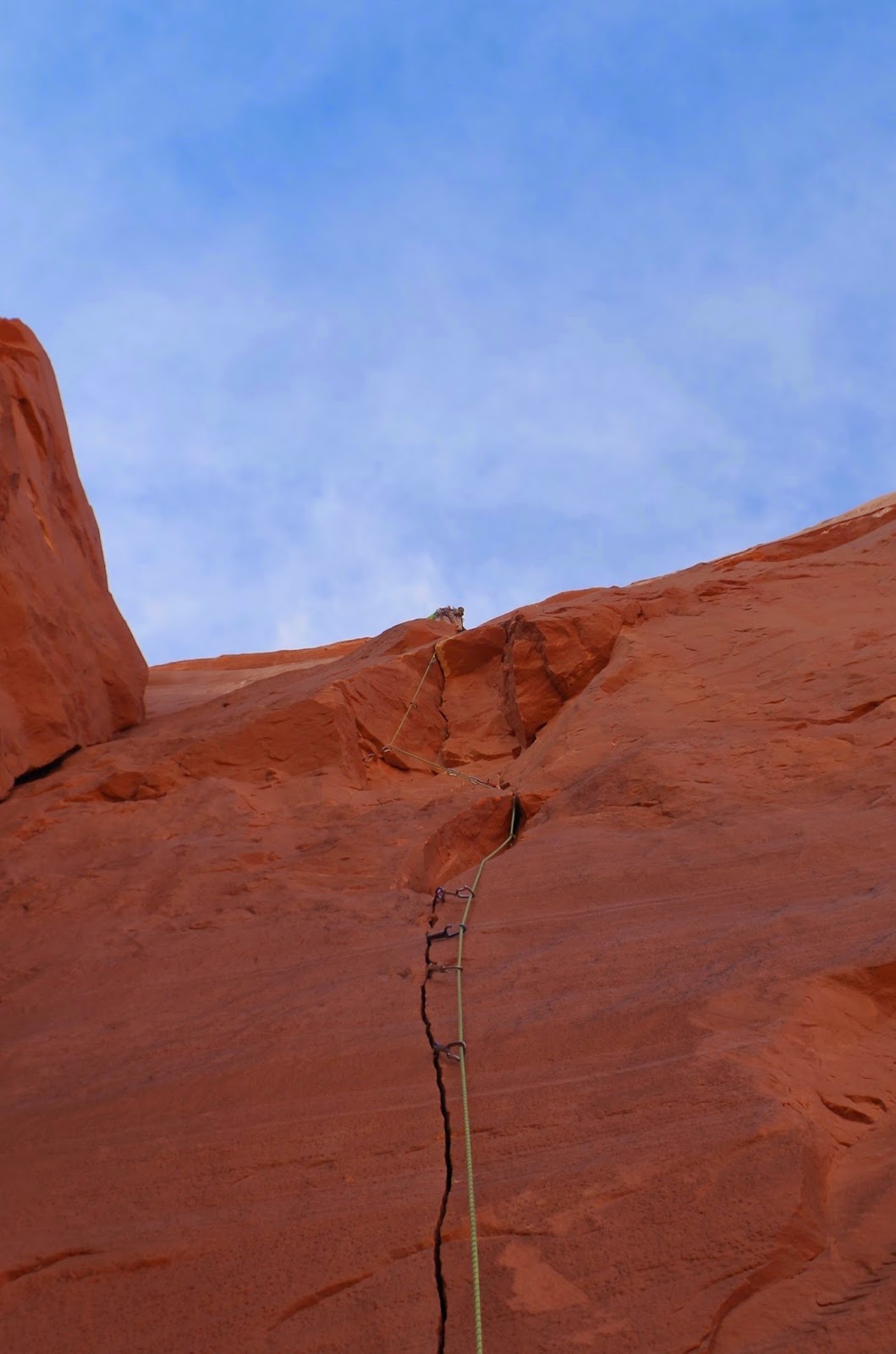
The start of Pitch 3 was clear but difficult to execute as it required some stretching and there was a loose block at the top (and bless his heart, Brent doesn't want to kill me with a falling rock) [It's our party we can do what we want.  It's our party we can say what we want].  The next 30 feet were a huge challenge though.  I've mentioned before that aid climbing is slow (and repetitive, like Miley's lyrics).  Instead of climbing up the wall like you would climb a ladder, using your hands and feet to move you up and leaving protection as you go just in case you fall (i.e., free climbing), aid climbing is more like building a ladder as you go.  Gear is placed in the features of the rock and attached to 'aid ladders' (webbing sewn into steps), the climber moves up by pulling on and stepping up the ladders.  In this way you can climb cracks that are too thin and small to climb using the strength of your hands and feet alone.  Aid climbing can get you to lots of really cool, seemingly un-climbable places, but it requires lots of gear.  Climbing without all the gear you want is decidedly not Type I fun.  
Note the aid ladders and harness full of gear.  
As Brent moved past his first two pieces of gear he found the crack could take a #0.3 Black Diamond Camalot (12.4 - 21.2 mm in width) ('cam') perfectly... and only the #0.3... nothing smaller or larger... for at least another 20 feet.  He could continue to "walk" the #0.3 up the crack, but it would leave an increasingly longer span between himself and his last piece of protection.  [It's our party we can love who we want.]  This simple math, measured by the rope, quickly added up to a huge risk, but with a potential payoff.  A fall, caused by that one #0.3 cam slipping or blowing out of the crack would lead to 1) shocking another tiny cam; or 2) decking on the belay space below.  But if he succeeded the crack might get wider or more narrow and allow him to use rock protection ('gear') of different sizes.  But it might not.   Since he was literally 10 feet above my head we could talk through this dilemma easily, but the answer wasn't easy.  [We can sing what we want.]
Note how far away that bottom cam is, that's the #0.30.  
The question came down to this: is the risk of falling low enough to justify continuing and increasing that risk, given the work we'd already put in and the reward of topping out?  And he asked me what I thought he should do.  Brent almost never needs my help with risk assessment.  I question myself all the time and rely heavily on Brent to help me assess risk, but he's the wiser and more skilled of us.  Because it was his life at risk I just didn't feel like I could make the call.  [But I could sing "Red cups and sweaty bodies everywhere.  Hands in the air like we don't care."]  I was literally no help.  I couldn't see when the crack would change size, but neither could Brent.  I couldn't tell how well that critical cam would hold, but he couldn't tell how long it would be before he could use something else.  We could both see how far away from the deck he was, we both knew how far we'd come and how much we'd like to reach the top...  It was a really tense moment (for me, Brent doesn't seem to remember it this way).  ['Cause we came to have so much fun now.  Bet somebody might get some now.]  I didn't want to tell him to back down because I trusted his skill, but I didn't want to tell him to move up because I didn't want to push him to put himself at more risk than he wanted, so I said the least helpful thing: "I can't help at all with this.  If you move up I'll be really worried and I don't see a way to climb down.  But I won't be upset if you want to bail."  Guess what was happening while I was doing all of this worrying.  Brent was continuing to climb, which continued to change the arithmetic of the situation.  [If you're not ready to go home, can I get a hell no?]
Moving up.
Then something amazing happened: the crack, through eons of erosion, widened enough to begin using more gear, spaced at more reasonable intervals.  But that's not the end of the difficulty.  ['Cause we're gonna go all night, 'till we see sunlight, alright.]  The crack got varied but also really soft.  And it was a really long pitch, ~180 feet.  [So la da di da di.  We like to party.]  And the wind started blowing, and it never stopped.    It was a difficult climb that stayed difficulty.  [Dancing with Molly.  Doing whatever we want.]  Brent spent about three hours climbing the third pitch, mostly out of hearing distance, so I had hours to stand there and think (while also giving a competent belay). [This is our house.  This is our rules.]   I studied my anchors (solid, painted nicely) and my Cinch and wondered if I'd ever read the owners manual (no);  [And we can't stop.  And we won't stop.]  I enjoyed the views and practiced left-handed SLR camera selfies (never take that brake hand off the rope).  [Don't you see it's we who own the night?  Can't you see it's we who 'bout that life?]  During this musing a few people pulled up next to the butte in side-by-side ATVs to watch and, thank the Lord (!), someone was listening to Dio loudly on their stereo.  
The Cinch
The top half of the pitch continued at a regular aid climbing pace (even and slow), but I had a great song to ponder the lyrics of.  [Holy Diver.  You've been down too long in the midnight sea.  Oh what's becoming of me?]  I still don't know what "Holy Diver"is about, but the song structure is more pleasing than that other song I was playing in my brain and the lyrics are more aggressive.  [Ride the tiger, you can see his stripes but you know he's clean.  Oh don't you see what I mean?]  Fact: after this trip "Holy Diver" became my power song when I program because it makes me feel like I can make the computer do what I want.  [Gotta get away.  Holy Diver.]  Anyway, I was enjoying myself there, safe from the breeze in my favorite flannel.  If I played my cards right I could start climbing with my new "Ride the Tiger" mentality.  And then it was my turn to climb.  [Shiny diamonds.  Like the eyes of a cat in the black and blue.  Something is coming for you.]   
The view from the bottom of Pitch 3
The first 30 feet of the route that Brent had struggled with were literally heinous (utterly odious or wicked)!  That lower part of Pitch 3 was a pretty perfect sized crack to jam my fingers in but was too tight for my feet to get any traction on, so I could hang but I couldn't actually move up.  [Race for the morning.  You can hide in the sun 'till you see the light.  Oh we will pray it's all right.]  It was a mess to belay.  Brent was more than 150 feet away and the wind was blowing, but that didn't stop me from yelling "Pull the rope!" every time I thought I'd lifted my hips enough for there to be slack in the rope.  [Gotta get away.]  Even though there wasn't any rope to take in and it is difficult to winch someone up on a top belay, Brent gave it a shot. Brent told me I could aid off that critical #0.3 cam, but he'd used it for that full 30 foot stretch so it was too far above my head to reach and I didn't have any other gear to use.  [Between the velvet lies, there's a truth that's hard as steel.  The vision never dies.  Life's never ending wheel.]  I'm still not sure how I got up that section of rock (Brent probably pulled me up), but once I got my hands on that #0.3 cam and rested I was back to singing "La da di da di, We like to party.

Brent at the top of Tombstone Butte
Most of the following 150 feet were perplexing but alright.  It took a lot of work to pull out the cams and stoppers that had been bounce tested.  There was lots of pulling and pushing and a good deal of tapping on gear, plus some strained prying with the nut tool.  [And we can't stop.  And we won't stop.]  The beautiful, brand new pink Tricam would not come out, even though I spent enough time on it that Brent had to question what I was doing.  Then it got torturous again: the crack widened and became more shallow.  [We run things, things don't run we.  Don't take nothing from nobody.  Yeah, yeah.]  It seems that at this particular section, about 50 feet from the top, a block of the cliff face had come off recently enough that the exposed rock didn't have any sort of hardened varnish, so it was just sand (read: NOT sandstone).  Everything I pushed and pulled on blew away because it was just sand.  [It's our party we can do what we want.  It's our party we can say what we want.]  How in the world had Brent protected this?  [Holy Diver.  You're the star of the masquerade.  No need to look so afraid.]


At this point in my complaining I must make a ridiculous confession: sandstone formations often look like genitals to me.  The towers make sense, descriptions of those often include the word "phallic"; but the cracks or canyon walls that are shaped like ovals with pointed tops and/or bottoms look like lady parts to me.  Thus, as I pushed my way up through this section I couldn't help but think that that must be what it looks like and feels like to be birthed as an adult.  [It's our party we can love who we want.  We can kiss who we want.  We can sing what we want.]  It felt just as silly and un-graceful as that admission sounds.  Once I got through this final difficulty I could see and hear Brent again, yay! [To my home girls here with the big butt.  Shaking it like we at a strip club.]   

Pitch 3
Getting to the top of things is usually a reason to celebrate, and it was nice to sit and catch my breathe, but it was actually quite unpleasant at the top.  It had taken me an hour to follow up the final pitch, and while I was bruising myself on the rock Brent felt like he was being punched in the back of the head by the wind.  [Remember only God can judge ya.  Forget the haters, 'cause somebody loves ya.]  On other towers we've explored the top a bit, looked for a summit register, and stretched a little before climbing down; none of that was happening there.  More than being unpleasant, the wind made exploring without a rope less safe and neither of us was interested in more wind or belaying.  [We all so turnt up here.  Getting turned up, yeah, yeah, yeahhh.]  

The top
Our choice to rappel immediately wasn't as easy as it would seem tough, because the bolts supporting the ropes we rappelled on weren't great, they weren't even OK.  All that wind (which is always stronger at the top of things than the bottom) and the soft, sandy sandstone made it so the rock the bolts were embedded in was literally blowing away.  Given time to think through things calmy we'd have probably searched for another set of anchors rumored to exist, but that didn't seem like a reasonable option.  [So la da di da di.  We like to party.]  So we rappelled very carefully, trying to keep an even speed and not bounce on the rope.  I wish I could say this was the first time we'd been left with this choice.  We arrived at the ground safely though.  


Of course there was one last selfie before we rappelled to our potential deaths
Once we were back safely on the ground you'd think the Type II fun would transition back to Type I, but it didn't.  That night a storm blew in, making climbing the next morning a no-go.  Not one to say 'quit' after driving for 6 hours to enjoy the desert, I decided to go to Canyonlands National Park for some sight seeing.  I'd never been to that park before and was definitely pleased with the views.  As an added bonus, we spent most of the day in the car with the radio, successfully dodging the stuck song issue.  


Upon returning home I looked at the Mountain Project description of the route and the first sentence stood out more clearly than on the first reading:  "Some interesting situations."  We were definitely faced with some interesting situations, even if the lyrics in my head were kind of inane.  Good times. 


Monday, September 1, 2014

Do What You Want and Be Nice About It

Today is the day we celebrate my brother's birthday, so it's an appropriate time to acknowledge just how blessed my life has been because of both of my brothers.  I've acknowledged how great my parents are and all three of my sisters, but a little brotherly love has been lacking.  My brothers, Scott and Ryan, are really, really great and as I thought about what exactly was so great about them I stumbled on some lessons I've learned from the way they've chosen to live their lives.  This seemed easier than picking illustrative stories, because my brothers are trouble makers of legendary status, so I couldn't pick just one or two episodes in two lifetimes of hilarity.  Scott and Ryan are certainly different characters, but being the only  boys in the family sandwiched between older and younger sisters, they tend to react to things in a similar way (which I've read is a habit of middle children) so I'm sandwiching them together for this celebratory post.  Scott and Ryan are some of the happiest guys I know and I always look forward to hanging out with them because they bring a lot of happiness with them.


1.  Do what you want.  
"I do what I want" is a common refrain in my family's home, and it seems most appropriate for my little brothers who do what they want through a mixture of poor impulse control, mischief, and nerd-level curiosity.  And they seem to be pretty happy guys because of it.  I could ramble on for days with stories of Scott and Ryan doing whatever they want (throwing rocks, spraying Windex at people, making stop-motion Lego movies) because its been a pattern in their lives.  If you ever run into my dad, ask him to tell you some of the stories about my brothers he's written down in the journal of embarrassing stories he keeps, you won't regret it.

Sometimes they just want to wear cereal boxes and forks while shouting "Decepticons."  I don't get it, but I love it.  
Sometimes they want to build sandcastles
And sometimes they want to play video games
2.  Be nice to people and good people will stick around you.
Ask anyone who's met my either of my brothers and they'll tell you that Scott and Ryan are the sweetest people you will ever meet.  It's the absolute truth.  I think karma has finally started working in their favor after decades of being great to everyone.  The long term friendships I've watched my brothers cultivate (I can't tell if it's too much disclosure to mention by name the "other men" in their lives (OK, I'm thinking specifically of Vince and Zach)) just warms my heart and I think the relationships bring joy to those involved.  Even better, my family has been blessed because these two guys have snagged spouses that are also great, so now I have two more sisters that I really like a lot.  Those lucky ladies really snagged themselves a couple of sweethearts.
Scott and Stephanie - 2011
Ryan and Brittney - 2014
3.  Wander until you find the right path for you.  
Scott and Ryan both have lots of stories about the times they've wandered away from my parents.  Scott got lost in Ogden City Mall looking for a comfortable place to nap, Ryan was found wandering the streets of Clearfield blocks away my folk's place.  Neither was running away, just wandering some place because they were curious.  This habit of meandering somewhere unexpected seems to be life plan for both of them, but it's worked out well, as far as I can tell.  I don't even know how many times Scott has declared a major in his academic journey or how many different jobs Ryan has had before he settled on the one's he in now, but they both seem to be doing remarkably well after years of experimentation.  And both have chosen interests that I never would have guessed intrigued them when they graduated high school.  Even if it comes after a few years of uncertainty, finding a career that feels right sure looks like it will be worth it.  And they're both pretty young, so it could all change again.

The whole engineering - computer programming course these guys have taken sometimes makes all the sense in the world, in hindsight.  
Scott near the beginning of his academic journey
Ryan near the beginning of that same journey

4.  Wear a helmet.  
My brothers are the most accident prone people I know.  Just last winter Scott actually cracked his helmet going over his bike handlebars on his way home from work.  Ryan spent most of childhood with some sort of wound due to crashing a bike or a dump truck.  I'm doing a bit of mind-reading here, because I haven't asked them about their feelings on bikes in quite some time, but I imagine they riding because it's super fun and maybe an accident here and there is worth it if you're having fun.  The thing I know for sure is that they're still with us because they started wearing helmets on their noggins before the really serious crashing began.  I also know that whenever I hear Queen's "Bicycle" I think of Ryan.  So always have fun, but through in a little common sense protection in when possible.
Ryan throwing rocks with broken arm
Scott also throwing rocks
So there you have it, do what you want but be nice about it and wear a helmet on your meandering journey. Love you Scott and Ryan!


Tuesday, August 26, 2014

Badass to Dumbass in Four Seconds - My King's Peak Adventure

The line between badass and dumbass is not only fine, it is a grey, wavy line, and in a different place for each individual. It’s hard to recognise, easy to miss, and painfully clear when overstepped. It’s the concept of pushing hard and not giving up, balanced against blind ambition and getting in too deep. Basically, when you start to get really scared, you are probably approaching your line.
-Leo Holding
I’ve got to start another blog with a confession – I was born and raised in Utah but it took me 30 years to finally go hiking in the Uinta Mountains.  I’ve done field work in some of the wetlands in the range and I’ve hiked a whole lot of other places in Utah, but I’ve never visited this range just for recreating.  And that’s unacceptable.  Fortunately I fixed that whole situation by visiting for a few days during my solitary-post-field-work-internal-battery-recharging-end-of-summer adventure.  The plan was to hike King’s Peak in a day and spend the next day fishing the head waters of the Bear, Weber, and Provo Rivers. 
Sunrise at Henry’s Fork 
The Uintas are a unique mountain range, being the longest east-west running mountain range in the United States, and critical to Utah, being the source of 90% of the water in the state.  The highest point in Utah, King’s Peak – elevation 13,528 ft, prominence 6,358 ft – is located in the High Uintas Wilderness.  Especially interesting to me, the Uintas are the source of the three rivers that provide most of the water to the Great Salt Lake and associated wetlands.  The Bear River begins on the North Slope of the Uintas and flows north through Utah, Wyoming, and Idaho before it ends in the GSL.  The Weber River begins in the western end of the range and flows along through some dang scenic Utah towns like Kamas before following Interstates 80 and 84 into the Ogden area.  Finally, the Provo River starts in the southwestern end of the mountains, is impounded in a series of Central Utah Project reservoirs before flowing on down to Utah Lake; the Jordan River flows out of Utah Lake into the Great Salt Lake. 
There are thousands of lakes nestled in the Uintas
The shortest trail to King’s Peak is 32 miles long, beginning at the Henry’s Fork Trailhead at 9,430 ft, then climbing 4,100 feet up to the peak through the Henry’s Fork Valley to Gunsight Pass, then Anderson Pass, finally up a boulder-y ridgeline to the peak.  Most people backpack it because there are some delightful places to set up camp in the valley and 32 miles in one day is a bit silly.  But I’m not a strong backpacker (backpacks make my shoulders feel pinchy) and the weather report I read suggested temps would hover between 30º and 50º, which is just too cold for me and my lightweight sleeping bag (its rated to 20º or so but I couldn’t imagine sleeping comfortably), so my plan was to spend the night at lower elevation (where it might get as warm as 60º) and do the whole out and back trail in one day.
The double-sleeping bag oven I could put together car camping
I figured my hiking pace averages two miles per hour, faster in flatter areas, slower in the steep places, so I’d need 16 hours to do the whole thing.  In order to get to the peak before the regularly scheduled afternoon thunderstorms I started at 4:00 a.m. 
4 a.m. Game face
I actually meant to start at 3:00 a.m., but I slept a little better than anticipated and don’t know how to work the alarm on my watch.  I went to bed pretty nervous as I listened to the rumble of thunderstorms to the north and south, but woke feeling badass and got a pretty strong start hiking in the dark.  I could hear the Henry’s Fork River below me and imagined it was beautiful.  The sun was rising as I entered the valley and was greeted with a view of the socked in King’s Peak
I misunderstood which of the peaks was actually King’s, it’s on the left side of the picture and it looked like this (cloudy) for most of the hike up. 
I hiked for four hours before I met anyone else on the trail, a group from Montana that passed me while I stopped to finish my coffee at the top of the valley.  We chatted a bit while they waited for their last hiker to catch up and they made me feel so cool.  I told them I was hiking the whole thing in a day and they told me how intense that was and they complimented my choice of morning coffee spots.  As they hiked away I felt like a pretty serious badass, I’d gotten up before everyone else and I was going to get down before them too. 
No regrets here, just enjoying the coffee and view
As I approached Gunsight Pass, the divide between Henry’s Fork and Painter Basin – elevation 11,888 feet – I passed my new Montana friends and gained some spectacular views as well as my first sighting of the weather I’d be dealing with at this higher elevation. 
Yes, it did snow that night.
I tore out a few pages from my hiking guide book and read them before heading up Gunsight.  I remembered the author said to follow the trail into Painter Basin, which takes away a few hundred feet of elevation, because it wasn’t worthwhile to scramble along the talus slope, but I got distracted by the site of some ptarmigans (yeah! a new bird) and misinterpreted “The trail does not continue through the low notch as easily as it may appear from below, however.  There are thickets and boulders here, and the trail switches back up the west slope to the pass…” as “…follow the boulders up to the pass.”  It wasn't that hard.  I’m just that hard core. 
SeeWhite-tailed ptarmigans.  
I’m loving Gunsight Pass
As I dropped into Painter Basin I was deliriously happy to see a whole bunch of beautiful wetlands.  I’ve been toying with the idea of shifting to studying high elevation wetlands when I finish this PhD journey (another one of those endeavors that fluctuates between badass and dumbass), seeing them there in the Uintas while I was ruminating about my future definitely made me decide that it’s a worthwhile (nay, badass) idea.  I did manage to look away from the wetlands briefly to glance at the trail ahead of me, just in time to see what looked like a black bear barreling through the bushes toward me.  I can’t ever remember what it is you’re supposed to do when you run into wildlife (other than don’t pet them), so I always just stand still while trying to make myself look as large as possible.  Lucky for me, I was wearing three layers of clothing that day so I looked huge.  Even luckier for me, it wasn’t actually a black bear; it was a hiker wearing a black balaclava and fleece jacket.  I told him he looked like a black bear when we crossed paths, but he seemed unmoved by the observation.
How great would it be to spend the summer looking at these wetlands?  Great.
Then the trail started to gain some serious vertical ground as it went up to Anderson Pass.  When I hit spots like this I imagine down-shifting just like a car so I can climb slowly but efficiently.  I felt alright about it until I looked behind me to see a couple trail runners were gaining on me.  I’d felt so proud that I dressed properly for my climb up past 13,000 feet (I’d really underestimated the weather at high elevations when I tried to climb the Grand Teton), then I saw these guys coming up the mountain in shorts, windbreakers and weird mittens.  Then they told me they’d started three hours after me.  But they were nice enough to chat with me about what they were doing and the speed they were going at, which left a pretty good impression on me.  One of the things I like about running is that it is so easy to rescale the effort based on personal levels of fitness and goals.  For me it’s enough to maintain 10-minute miles for the course of a marathon, I don’t need the same 4,100 foot elevation gain those runners did.  Chewing on the things that are great about running and hiking got me through the next 1.5 miles or so, until I realized I needed to start munching on something with real calories because I kept losing the trail.  But really the trail had just petered out into rocks and tundra plants. 
Tundra plus marmot
As I got within a mile of Anderson Pass I started running into hikers going downhill so I asked them if they went for the peak to get an idea of the safety.  No one had, some had no intention of it and others didn’t like the look of the storm.  As I sat eating my pepperoni and string cheese, feeling the sting of a little snow, I dug into the bravery reserves I keep inside and decided the clouds weren’t nearly formidable enough to stop me and committed to going up.  Plus I could see the trail runners ahead of me and they looked epic scrambling along the ridge line. 
Socked-in weather before I headed up
The last mile to King’s Peak was a combination of feeling pretty cool and pretty lost.  I’m not a strong path finder and there’s not actually a path up to the top.  Instead, you just kind of head over boulders up and to the south until you find a flag at the top (but not a USGS summit marker, which is over on South King’s Peak).  I tried to channel my inner mountain goat to make a speedy ascent, continually looking around at the clouds and adding up the amount of time I’d spend unprotected from potential lightening.  A mountain goat wouldn’t be scared of lightening.  A mountain goat wouldn’t be so gassy.  A mountain goat is a badass and my spirit animal.  (Fun fact – I just googled "burping at high altitude" and found out that "high altitude flatus expulsion (HAFE)" is a real thing.  As air pressure decreases with altitude, the internal pressure created by intestinal gasses increases and makes hikers burp and fart as they get out of their comfort zone.  The first result of my google was a list of terrifying symptoms of HAPE and HACE, pretty scary high altitude diseases.) 
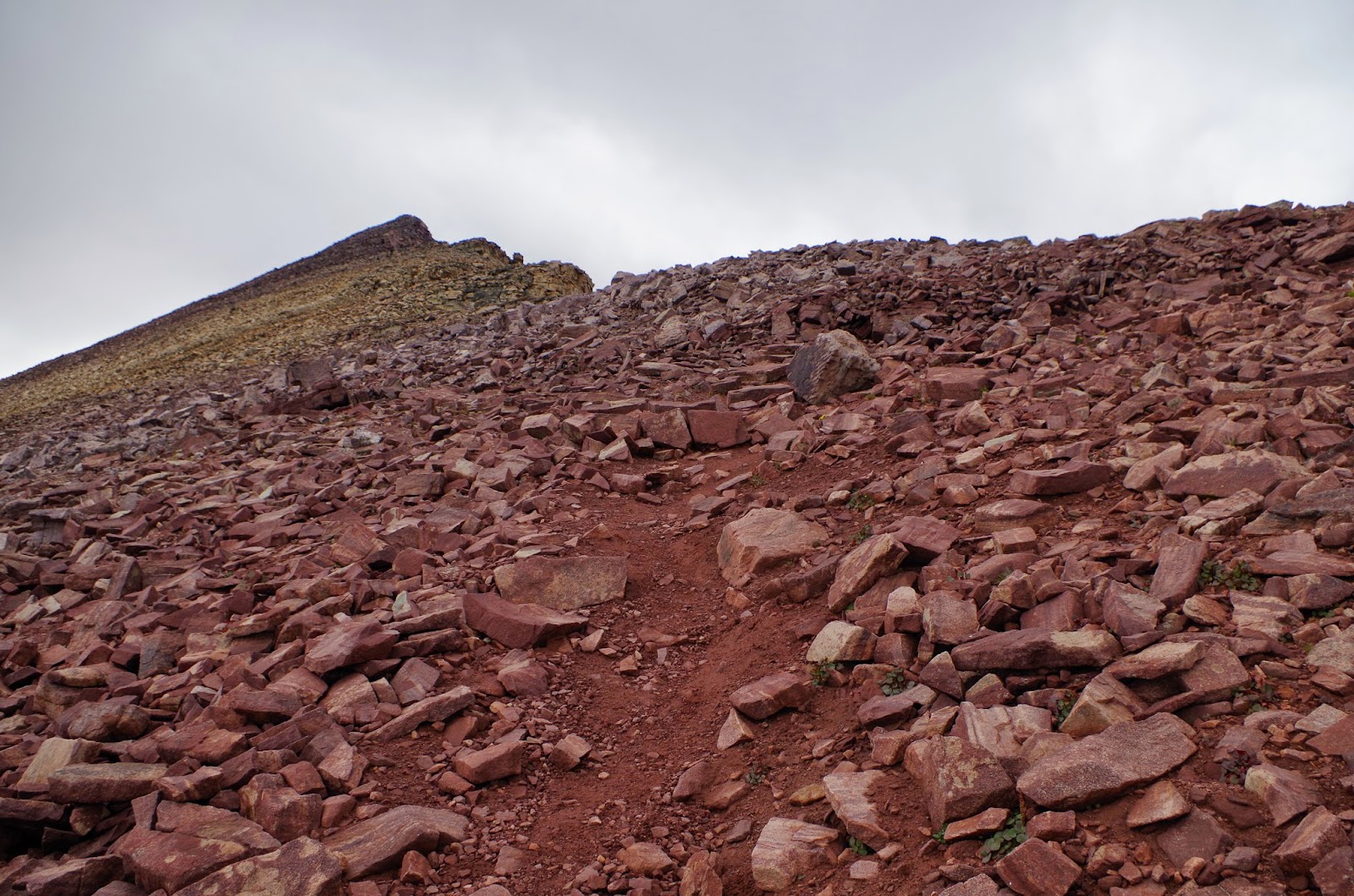
Isn’t that a beautiful hike
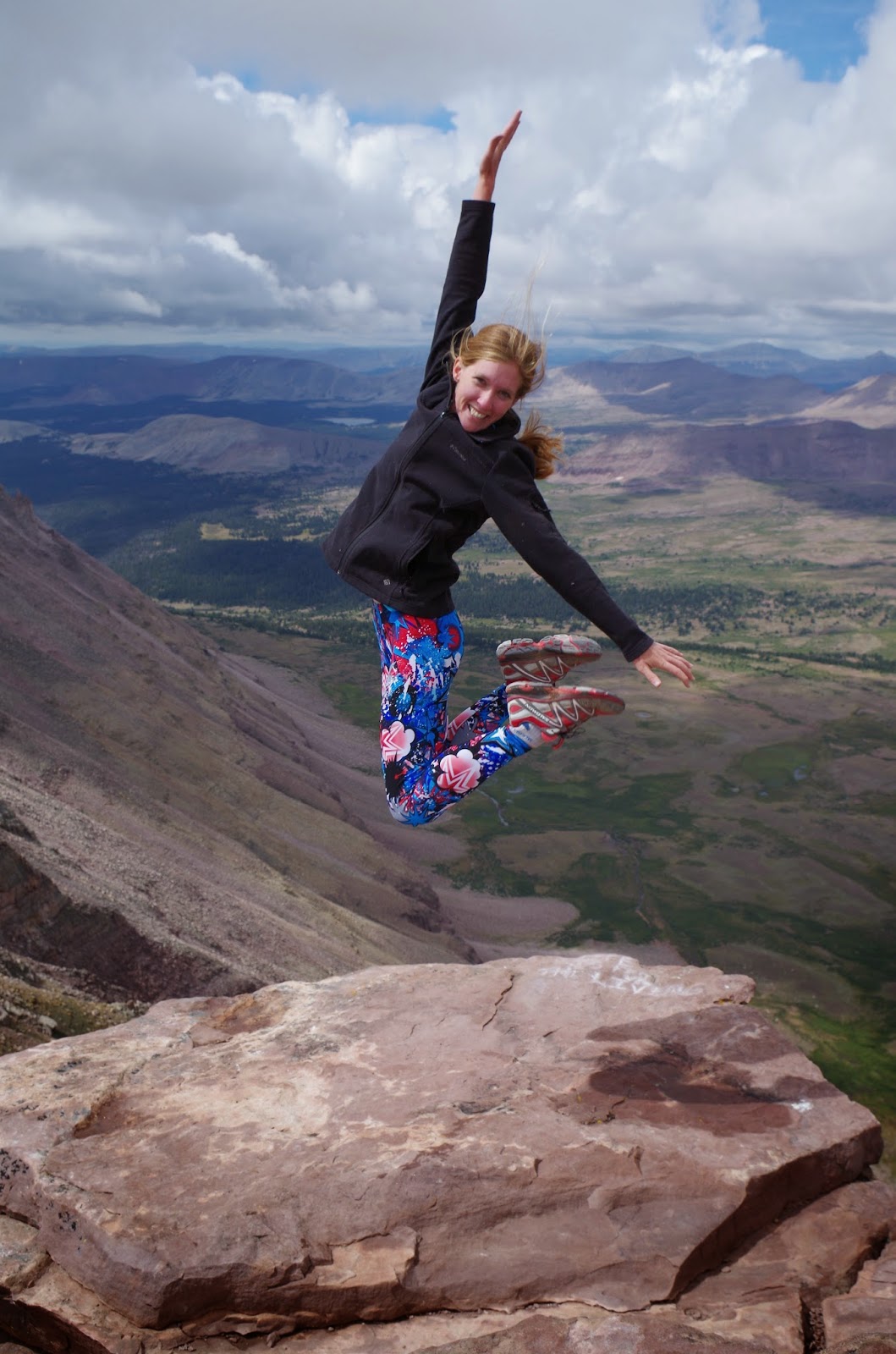
It took me an hour to mountain goat my way to the summit.  It was pretty fun to think about how deep the giant pile of boulders I was jumping on was, but also unsettling when a boulder shifted.  I had several minutes to myself at the peak, a time I got to enjoy the sun, update the summit register, bring out the racing tights, and do a little mountain yoga. 


Mountain warrior
The group from Montana caught up with me shortly after that and helped me take a great jumping-at-the-summit picture and just made me feel like a badass.  I felt cool because I’d made the summit in a day, had my kick ass tights on, was willing to jump near the ‘edge’ of a 2,000 foot cliff (it wasn’t that close, I was totally safe), and I did it all by myself. 
I really enjoyed being able to chat with the folks from Helena, I think it’s cool how being on the mountain can make everyone a kindred spirit.  But they also helped pump my ego up until it was almost ready to burst (I don’t think the low air pressure around helped at all either).  I was elated on the way down.  The views were so amazing…
The arêtes and headwalls of this range are still being shaped by ice and frost, which reaches into cracks in the rocks and fractures it (“splits it asunder”), leaving sharp, angular faces that will eventually be buried in their own rubble.
The signs of life, while short in stature, were very cool.  A few months ago I learned that lichens can grow in space, so it seemed especially cool so see them up on the talus slopes I’d seen referred to as a moonscape. 


The Uinta Mountains were created by two tectonic events.  The first was a north-south compression that buckled the crust and exposed the sedimentary rocks that make up the mountains 60-65 million years ago (they’re actually meta-sedimentary, sedimentary rocks like sandstone and limestone that have been under compression long enough to begin changing into metamorphic rocks like quartzite and slate).  The Uintas reached their current 13,000 feet elevations about 15 million years ago as tectonic forces lifted the range along an anticline. 
Parting shot of the King’s Peak cliff face, ice is still eating away at the rock while gravity is helping build the large talus slopes at the bottom 
Evidence of glaciers at lower elevations
"Felsenmeer" – the ‘block top’ peaks between 10,000 and 12,000 feet that haven’t been touched by glaciers, composed of rubble that has accumulated in place due to “sustained severe climate”, above the U-shaped glacier carved valleys of the Painter and  Uinta River Basins.
All of this pre-historic uplift and erosion made for a long hike down.  I started to think of the tundra moonscape more like a hell-scape that I wouldn’t ever get out of.  The little tundra plants that I’d thought were so cool before just bothered me now because they didn’t yield to compaction, making it difficult to find the trail.  After chewing over the term ‘hell-scape’ for a few miles and realizing that I was cold and hungry again, I decided to have lunch on a big rock over looking Painter Basin.  I reached “Peak Badass” on this rock eating a cheese and humus burrito.  Along came a hiker named Corey who was doing the really badass High Line Trail (73.4 miles, 9 major peaks, “nonstop views and rampant wildlife” according to Backpacker) over the course of several days.  Despite his clearly more intense badass-ery, Corey was nice enough to pump my ego up a little more, as it was clear I was the only solo female hiker on the mountain that day, and it seemed the only one doing the peak in a single day.  This was especially nice of him as the effects of HACE may have been settling in and I was having some trouble following basic conversions (i.e., “My name is Corey, it was nice to meet you.”  “My name is Becka, what is your name?”).  In the 10 minutes I’d been sitting on the rock the weather had changed dramatically, as it is known to do in the Uintas, so Corey left noting “The gnar is coming in.” and I started to pack up my stuff and add a layer of clothing.  I felt very hardcore.    
The gnar coming in
The snow hit with a vengeance.  It was beautiful, but made for slippery hiking.  I passed Corey as he was getting out rain gear and asked if he was ready for snow while I pulled out my own rain coat.  I’d been pondering whether lightning can actually accompany a snow storm when something shocked my ear.  KERRRACH BOOOOOOOOOOOOOOOOOOOOOMMMMMMMMMMM!!!!!!!!!!!  Lightning struck close enough to shock me and shake the ground!  My ego popped, all signs of badass-ness fell away.  I yelled out something to the effect of “I’m going to cry” and started running down the trail, single mindedly focused on getting to tree line or shelter of some sort.  I looked like a dumbass.  Arms out, feet kicking, slipping and sliding, literally landing on my ass several times.  I felt ridiculous too.  It seems like a childish strategy to run away from things that are scary as fast as possible, but that was my strategy in that moment.  Tree line was still about 2,000 vertical feet and 8 miles away.  There were some nice shrubs down in the basin 0.5 miles away, but the storm had cleared by the time I got there. 
Not just snow - thundersnow!
Ten minutes later, once the storm and my head had cleared I stopped to sit and think about what a dumbass I was, and shake my legs out enough to stop slipping and falling.  Of course lightning can strike during a snow storm, precipitation all comes out of clouds, which are the source of lightning too.  More research on my part has indicated that there is a thing called “Thundersnow” and that it is relatively infrequent and localized and terrifying (that same research showed that other people have pondered the same thing as me, just not during a snow storm, so I was only half a dumbass).  Nothing in my research indicated being a fast-moving target was an effective strategy for avoiding lightning strikes (though I did read the opposite advice “Better late in this world than early to the next”).  I waited for a minute or so, trying to catch of glimpse of my fellow hiker and feeling like an ass.  I'd just been thinking it was so great that everyone on the mountain takes care of one another and I then literally run past another hiker like a scared little girl.  I did eventually see Corey hike on through the basin after our trails had departed, so I could still feel like a dumbass, but at least I knew he was safe. 
Crossing Henry's Fork
The rest of the hike was relatively uneventful, but very long.  I did a bit of wild flower gathering and noticed the similarities between the few genus’s of plants you find in wetlands and at high elevations, because there are only a few groups of plants that seem to be able to deal with such extreme water stresses (drought/hypersaline water vs. ice).  I ran into my friends from Montana again, somehow already back at camp and looking very comfortable.  I tried to revisit the bottom half of the trail with new eyes, since I hadn’t really seen what it looked like when I was hiking it in the dark.  Most of my energy went into trying to rid my head of awfully annoying songs (there’s something popular right now that says “I don’t care, wo-oo-oo-oh, I really don’t care” over and over again and I hate it) and working to avoid calculating my hourly pace.  There were some dark times. 

I wandered back to camp site 15 hours and 20 minutes after I started, which was 40 minutes earlier than I had originally estimated, so I patted myself on the back for finally beating my habit of sandbagging time estimates.  I patted myself on the back again as I cooked up the steak I’d had marinating for the past day, it was a great reward, even if I had to eat it under the hatch door of my car because of another rainstorm. 
The peak really cleared up that evening, it's that beautiful peak in the center.  
King’s Peak was probably one of the best solo adventures I’ve been on, in part because of those large swings in confidence than any long and tall hike should bring with it.  It’s also just an amazing and beautiful hike.  I’d like to do the High Line Trail now that I’ve learned a lot more about the geology of the region so I can understand what I’m seeing, plus I’d have a year to build up my bravery stocks.