Monday, October 14, 2013

Breathe Taking Moments on Antelope Island

Day 2 of my Great Salt Lake Spectacular was an Antelope Island Adventure!  The whole day was an emotional and enlightening experience that I was able to capture while I was trapped in my tent by a lightning storm.  While this trip happened more than a month ago, the discussion of planning has struck me as particularly relevant to current issues with both life and vacation planning.  Turns out I'm no good at planning and prefer to be adaptable, but that isn't fair to others when going on vacation or wending your way through life.  There also some revelations about the moments that were missing from my day to day life.  Here were my thoughts while trapped in my storm-battered tent -
I did not intend to be hunkered down in my tent before 9 pm, hoping not to be struck by lightning, but that seems to be the plan the weather gods had in mind.  A few times today I tried to finish the phrase "the best laid plans of mice and men..." but I don't know how it ends and I don't have well laid plans.  I have adaptable plans.  Today, for example, I was originally going to hike Mt. Ogden, then Frary Peak.  Yesterday while I was hiking down Box Elder Peak, looking forward to chilling next to the Spiral Jetty, I decided an exclusive Antelope Island day was in order.  I juggled around plans for the day and kept to 1) hike Frary Peak, 2) kayak, 3) take pictures of the sunset.  But #2 was cut short by rumors of 90 mph winds in Wendover and #3 was hastily ended after a thunderstorm rolled through.  But its been a good day.

Here's the thing I've been discovering this trip: it is absolutely vital to have moments that make you stop and say "How great/lucky is it that I'm here experiencing this awesome thing?"  Its the question I ask Brent at the top of our coolest climbs.  Its what I asked myself yesterday on Box Elder Peak when I caught a view of Bear River Bay and met a 50-60 year old man who was hiking unconventional routes up and down the Wellvilles.  I stopped everything and questioned my luck when I had the Spiral Jetty to myself for an hour.  Then this morning I found some new-for-me plant species on the beach and got to do some profoundly awesome outdoor yoga under a cottonwood tree.  I howled, head and shoulders back, at the top of a mountain I had all to myself.  I was timid at first, ca-ca-ing and howling quietly, but the greatness of the beautiful, lonely landscape required multiple, soulful howls.  I got to kayak with Phalaropes, they were so many of them it sounded like the wind when they all took off flying.  I saw a sunset in colors I could not capture with my camera, but cannot forget.  And I saw lightning in spider web patterns that I had never seen.
Turns out the saying goes "the best laid schemes of mice and men often go awry."  Which is appropriate.  This whole trip opened my eyes to the importance of "Oh My Goodness" moments, which are generally missing from everyday work, but easy to attain while running or hiking or biking or even just eating a good meal.  Below is a list of Oh My Goodness Moments from my day on Antelope Island, along with a few fun facts.
  • I saw a some new and old plant species on the beach at Willard Bay 
Mystery Sedge.  Sedges form the genus Carex, which is large and difficult to identify.  Fun fact: Googling "round sedge, Utah, lake shore" does not turn up pictures of this sedge so I don't know what it is.  
Schoenoplectus maritimus - alkali bulrush.  This is one of my favorite plants and is an important habitat species in wetlands around GSL.  Alkali bulrush can tolerate pH as high as 9.0 and water depths up to 1 meter.  It is considered a pioneering species, one of the first species to colonize disturbed areas.   
Cyperus esculentus - yellow nutsedge.  This plant is considered a weed in many parts of the country, but I haven't seen it in any of my field sites, so I was excited to see it.  In parts of Spain the tubers of this species (which is clearly widespread) are used to spice Horchata.
  • I had an unexpected chat with my mom and dad - it's always nice to talk to my folks.  
  • I howled on top of Frary Peak
Frary Peak is the tallest point on Antelope Island at 6,596 feet.  Fun fact - this is the only jumping picture I was able to make work during my entire GSL Spectacular.  
This is all that is left of Farmington Bay right now.  Snowpacks in 2012 were 30-40% of normal, 2012 was 75% of normal.  If we don't shake this drought I won't be able to finish my PhD, so do your snow dances!
The gneiss of the Farmington Canyon formation on the southern 2/3 of Antelope Island are some of the oldest in the state at 1.7 billion years old; this formation has been referred to as Utah's Pre Cambrian "basement" rock.  
I was very happy to be there.  
While the island as a whole is quite dry, there are more than 40 isolated freshwater springs that support wildlife populations, primarily on the eastern side of the island. And the shifting shorelines of GSL also provide habitat for wildlife as halophytes (like those I talked about last week) colonize exposed mudflats.  
  • I ate Humble Pie when I remembered laughing at Scott on the "Mordor" section of Frary Peak
During a trip to Frary Peak a few years ago (documented here), I made fun of Scotty because he was scared of the height and drop off of the steep part of the trail.  But when I was there by myself I found it equally scary.  It was humbling.  
And just like that trip a few years ago, I stopped to pose with this tree.  Fires come through the island regularly and are an important part of balancing competition between grasses and trees.  
  • I tried trail running photography with an SLR camera.  
Much of the trail was relatively flat and relatively flat trails are made for trail running. 
Running with a large camera looks like this.  
Then I stopped running because I didn't want to trip and fall with my big camera.  

  • I floated with Phalaropes
Before I got to the Phalaropes I passed an antelope.  There are about 230 pronghorn antelopes on the island, it's pretty great to see them.  
12 bison were brought to the island in 1893 and produce what might be the oldest and largest publicly owned herd in the country.  This herd has a unique allele not found in other herds in North America.  The herd is rounded up each year, and the year I saw it was a kind of traumatic event for me.  
Gulls hanging out on dikes around the marina.  Most gulls on the rookeries around the island are either first year juveniles or mature adults; immature gulls usually fly west to mature and then fly back to the GSL to breed.  
Phalaropes are long-range migrants and when they stop by GSL they enter a hyperphagic state where they eat so many brine shrimp and brine flies they gain up to 50% of their body weight.  Oddly enough, studies of stomach contents suggest females prefer brine shrimp and males prefer brine flies.   
500,000 phalaropes, about 1/3 of the world's population, stage at GSL.  And when they fly away it sounds like gusting wind and it's awesome.    
Eared grebes also enjoy feasting on the salty goodness of GSL.  Over 2.5 million grebes visit every year, which at times is half the North American population.  
  • I thought "There is no way I'm going to be stuck in a ducky in a microburst storm."  
As I got ready to launch from the marina, the manager told me there were 90 mph winds in Wendover so I should be careful.  I spent the whole time looking for dark water where winds were causing the water to mix.  I didn't see any, but I did spend the whole time tracking the clouds trying to figure out if I was going to get swamped.  
Microburst storms happen when large thunderstorm clouds create temperature stratification in the atmosphere and subsequently huge down drafts.  They're pretty scary and awesome.  Those clouds on the horizon did signify a coming storm, but it took a few hours.  
Duckies are pretty great for toodling around GSL, but I've had some bad experiences with wind and didn't think an inflatable raft would really stand up to microburst winds.  
  • I learned about oolites.  
The white sand beaches and dunes are composed of oolitic sand.  Oolids are brine shrimp fecal pellets surrounded by concentric ring of calcium carbonate.  
Ooid particles are rolled around by waves on the bottom of the lake until they form into larger round and egg-shaped particles that make the sand quite slippery.  
And here's a brine shrimp, the organism responsible for both the high concentrations of grebes and phalaropes and the oolitic sand!  
  • I viewed the sunset, met new people, and fled a thunderstorm.  
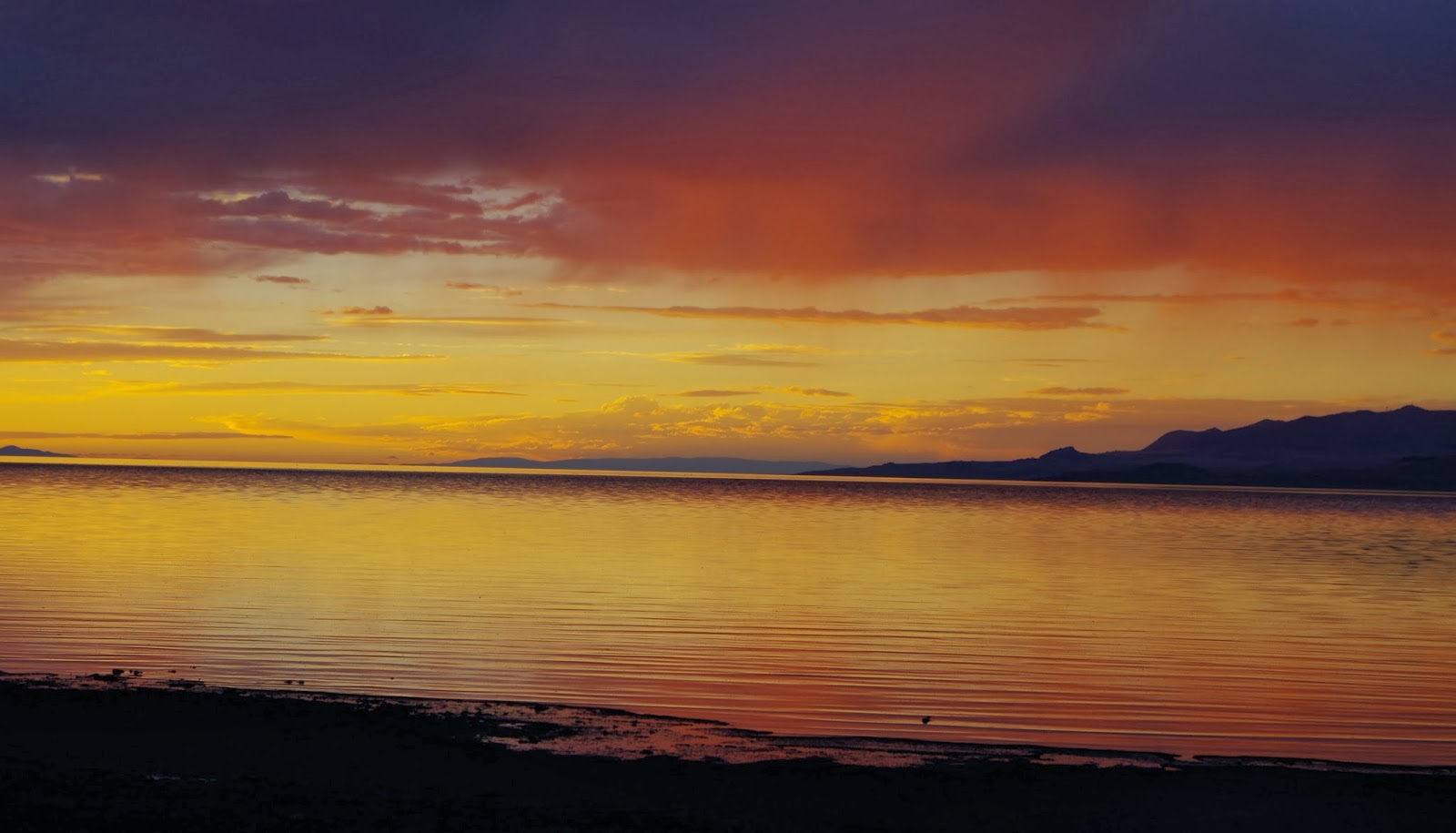
I love GSL sunsets!  So I took lots of pictures, which I really enjoyed because the clouds were being so dramatic.  
It was a particularly great sunset because I could see Box Elder Peak from my vantage point, it's that point in the center the sun if focused on.  
The colors got more intense the lower the sun got, and I didn't notice a storm coming in fast from the south.  Once I got done taking pictures I had to run as fast as I could across the slippery oolitic sand, hoping the tripod I was carrying did not enhance my odds of being struck by lightning.  
  • I threw a rock in my tent to hold it down.    
I was very impressed by how well the tent held up, and once the storm passed I had a nice night there.  

Thursday, October 10, 2013

Spiral Jetty - Salt

I have said many times that the Great Salt Lake is the greatest and here I'm going to try to make the case for that.  My PhD work focuses on the fresh and brackish parts of the lake, but the really salty parts are what make it so cool.  Stop # 2 on my August Great Salt Lake (GSL) Spectacular was the Spiral Jetty.  This was my fourth trip to the Jetty, and each time I go the Lake and the Jetty look different.  The focus of this trip was to capture the sunset, so there are many pictures of that.

Best sunsets on the planet are found at the Great Salt Lake.  
However, pictures of the sunset are not terribly interesting, or at least not as interesting as the science of the GSL.  So I've decided to use the pictures to guide, in general, my list of reasons the Great Salt Lake is truly the Greatest!    

This move is meant to demonstrate the greatness of the Great Salt Lake and the awesome-ness of chilling out on the Spiral Jetty.  

1.  History - As I mentioned in my last post, GSL is all the remains of Lake Bonneville.  Lake Bonneville drained quite a bit when an ice dam at Red Rock Pass failed, but what really lead to it's transformation into a hyper-saline terminal lake was a change in climate from pluvial (extended period (thousands of years) of abundant rainfall) to semi-arid (evaporation rates exceed rainfall rates).  Lake Bonneville was huge, so massive it actually caused the earth's crust to flex into a depression under the lake.  As rainfall decreased, so did inflow from rivers, lowering the level of the lake past any potential outlet points.  The longer the climate remained dry the lower lake levels fell and the more concentrated minerals in the water became because rivers kept bringing in salts but as water evaporated it left the salts behind.  [Super fun fact - layers of sediments exposed by gravel pits have been one way geologists continue to learn about the history of Lake Bonneville.]

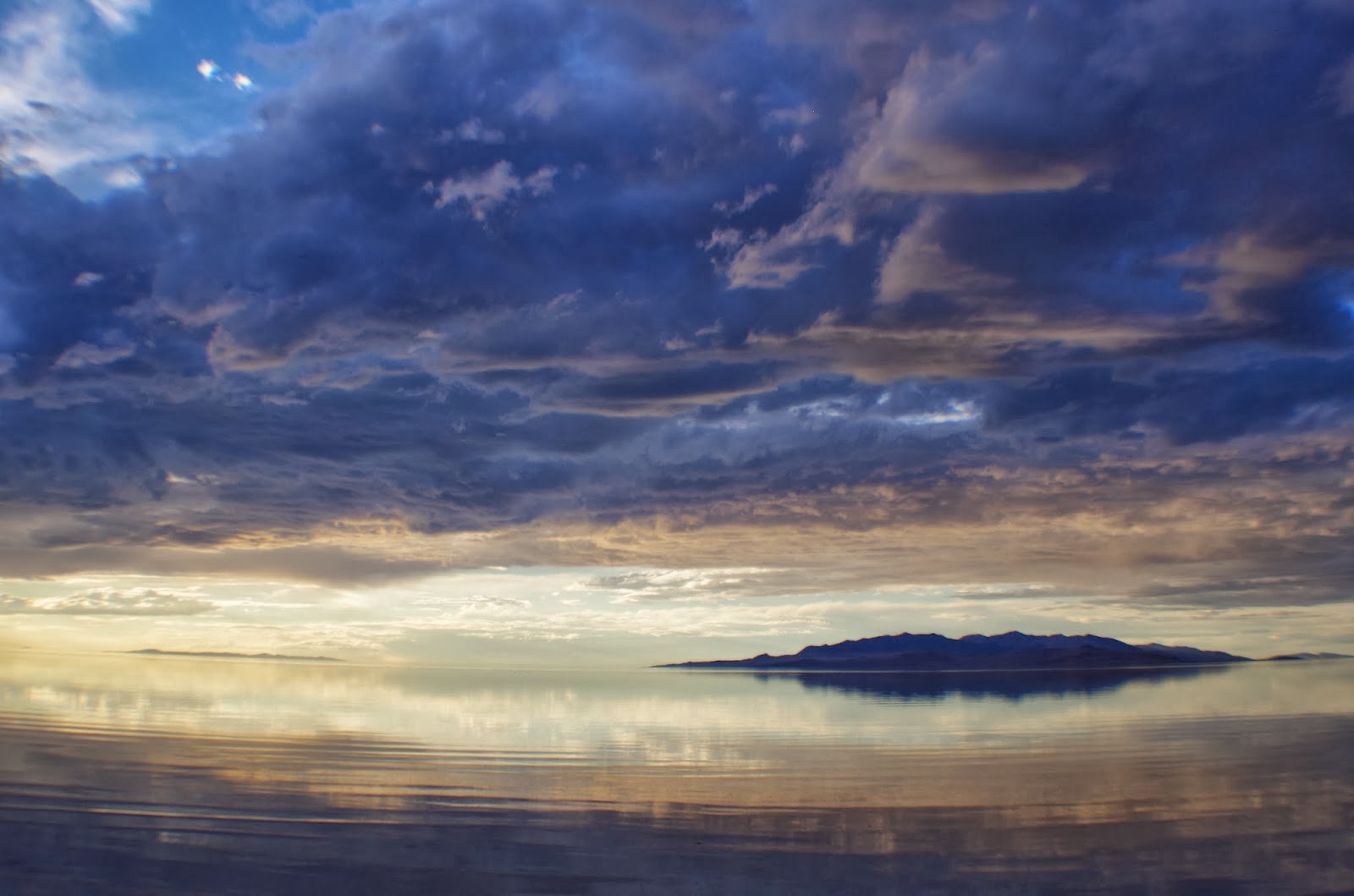
View south from Rozel Point - the terraces on the mountains around GSL are evidence of the shifting water levels of pluvial Lake Bonneville.  

2. Dynamic hydrology - As if a history as a gigantic lake was wasn't enough of an interesting hydrologic dynamic, the lake level is still changing all the time.  In the last 150 years, the Lake's depth has fluctuated by 7 meters (about 23 feet); however, because the lake bottom is so flat and shallow (mean water depth is 5.5 meters (17.4 ft)), that change in water depth translates to the surface area doubling between the lowest and highest water levels.  This means the location of the shoreline can change every year depending on the snowpack and seasonally as evaporation rates rise and fall.  Shifting shorelines have been troublesome in flood years, and during drought years it means you have to hike a long ways to get from the beach to the water.  But it also has an important role in ecology - when freshwater marshes are flooded with hyper-saline waters it re-starts the successional process, essentially setting the plant community back to what it was decades before.  And when mud flats are exposed during drought years they end up being super-tasty buffets for shorebirds who love bugs.

Those dark patches are "craterlets" of oil exposed by low water.  There are actually natural oil seeps at Rozel Point, but oil extraction proved unprofitable due to the sulfur-rich nature of the oil and the difficulties of pumping under both flooded and dry conditions.  

I have no idea what these large metal spheres are, but I see them frequently around GSL.  I really like that someone drew an alien on this guy.  
3.  Halophytes - Birds migrate in and out of GSL when food is most abundant, but there are plants, bugs, and plankton that not only stick around GSL, they thrive there.  They're called halophytes and they are able to live and reproduce under salt conditions that would make other plants and bugs wither up and die.  My favorite halophyte is a plant called pickleweed (Sarcocornia utahensis), not only is it adorable, it concentrates salt in it's tissues so it can be used to pickle things in your kitchen.  Outside the marshes, in the open water of GSL, brine shrimp (Artemia salina and some others) and brine flies (mostly Ephydra cineria) live in water more than 3x saltier than the ocean.  Birds love this highly productive food source (the shrimp and flies), and fish would love it too if they could live in such salty waters; since they can't, brine shrimp cysts are harvested every year and shipped across the country to aqua-culture facilities.  In the places saltier than the main body of the Lake, like the North Arm of GSL, the water is completely saturated with salt and only bacteria and cyanophytes can live.  These organisms are not only cool because of their ability to survive harsh environments, but also because they turn the water pink.  Even cooler, cyanobacteria are part of the oldest kingdom of living things on earth and mostly likely contributed enough oxygen to the atmosphere billions of years ago to create the oxygen-rich, breathable atmosphere we have now. 

Very shallow, salty and pink water of the North Arm.  This vivid landscape was an inspiration to the creator of the Spiral Jetty.  

New salt crust - the salt forming process also ended up being an inspiration for the Spiral Jetty.  

4.  Minerals - It should be clear by now that salts are an important characteristic of the Lake.  Turns out, every year more than 2 million metric tons of minerals are removed from GSL.  Using solar evaporation ponds -where salty water is pumped into very shallow ponds and allowed to evaporate, thus concentrating the minerals in the water and some more complicated refinement techniques - companies are able to extract sodium chloride, magnesium chloride and potash (sulfate of potassium) from the Lake for many interesting, occasionally surprising uses.  Magnesium chloride can be used a dust suppressant, and  can also be further processed into magnesium metal and chlorine gas; unfortunately this process is highly polluting and one of the mineral companies on the Lake is the biggest polluter in the State because of it.  Potash is used as a fertilizer and I can't find many fun facts about it, but I think it's cool that a lake whose water is useless for farming produces a product necessary for large scale farming. 

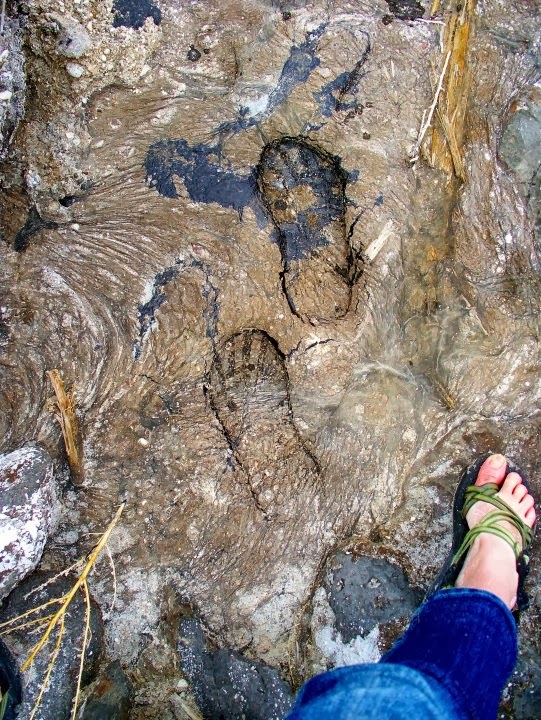
The high concentrations of minerals petrify wood placed in GSL water, but those high concentrations are also what make mineral extraction profitable.  
 Table salt (sodium chloride) is processed for industrial use and livestock salt licks, but a good chunk of it is also used to de-ice roadways in Utah, which leads me to my next subject... 
Older salt crusts... I guess it's not so much a crust...  Mmm.  Salt art.  
5.  The GSL weather - It's hard for me to pull the way GSL affects the weather on the Wasatch Front from the way GSL is affected by the weather, but I'll give it a try.  First is my favorite - Lake Effect Snow: because of it's elevated salinity, the GSL doesn't freeze in the winter.  This open water creates a kind of "hot spot" with lower pressure than the surrounding cold air; when large cold air fronts converge with this warm air it produces snow storms that drop several inches of snow over the communities near the Lake (including Clinton, where I'm from).  Then trucks full of GSL salt come around in an effort to keep the roads dry through the same freezing-point depression principal that keeps the Lake from freezing.  Wind is a pretty big deal around GSL, too.  Because the Lake is so large and flat, wind can really pick up speed across the water, and it kind of picks up water along with it.  Storm seiches around the Lake can lead to 2-foot differences in the water surface between one end of the lake and the other as wind pushes water ahead of it, and then the water sloshes back.  This in turn has led to trouble demarcating the shoreline that already fluctuates a great deal.  Finally, there are micro-burst storms that bring INTENSE winds with them, but I'll go into that in more detail in a future post (where I discuss how scary GSL micro-burst storms can be while running across the sand with a metal tripod). 

Storm clouds followed me around my GSL Spectacular, which made for an infinitely better (read: scarier) experience.  


6.  The Spiral Jetty - The Spiral Jetty is an earthwork created by Robert Smithson in 1970, composed of 1500 feet of rocks from the shoreline that were moved with bulldozers into the mud in the shape of a counter-clockwise spiral.  While that seems awfully permanent, Smithson actually intended for the work to be inundated and exposed over the course of time and hoped that salt crusts would form on the rock to change the way it looks.  I'll end with a quote from Smithson and the recommendation that everyone take the time to visit the Jetty while it's above water.  The road to get there has been improved significantly and the feeling of walking on the Jetty can't really be explained but should definitely be experienced.  The hour I spent by myself hanging out on the Jetty was pretty great, but I highly recommend visiting with a friend, an artist friend if you can.  
"Through the vaporous abstraction of Box Elder County, Utah, I beheld a wide expanse of lake, whose waters were so bloody a hue as to bring to my mind a geography of unspeakable carnage.  Yet at the same time, a voluptuous color prevailed.  A luminous languor coupled with a foreboding sense of menace produced gyratory dimension.  Innumerable spirals flashed from the lake, assuming no distinct or definite existence, but instead whirled off into burning distances.  There are times when the water flows like scarlet syrup, and times when it faces into colorlessness.  (Robert Smithson)"
August 2013
August 2013

August 2013
Oil Seep - Rozel Point - April 2010
Storms coming into the Jetty - April 2010

Ever present storm clouds - October 2010

Note - my Places to Go, Things to Do page has the coordinates to the Spiral Jetty that can be used to make yourself a map to get there.  Other directions also exist on the Internet, so go and see it (and remember that there is no cell phone coverage out there).  


And if you're in the mood for a read about the Great Salt Lake, check out this book - http://ugspub.nr.utah.gov/publications/dnr/GSL2002.pdf


Saturday, September 14, 2013

The Wellsville Mountains - Then and Now

A few weeks ago I went on a solitary vacation that started with a hike up to Box Elder Peak, the highest point in the Wellsville Mountains.  One of the things that struck me while I was hiking was how my attitude changed with every 500 feet of elevation gain.  A large part of my major attitude shift was the fact that I couldn't see my destination until I was right underneath it, thus every time I realized the peak I thought was Box Elder was not in fact my destination, there was heavy disappointment.  Here's the general flow of emotions: 


  1. Excited 
  2. Nervous (elevation gain) 
  3. Nervous (storms) 
  4. Nervous (animals) 
  5. Despair (I could turn back now, I've seen enough) 
  6. Cold (the wind blows at the top of mountains) 
  7. Tired (legs) 
  8. Tired (mind 
  9. Done

I think this is a pretty general outline of how hiking goes (I recall the term "A Fine and Pleasant Misery"), but it seemed more acute due to some fun facts of the Wellsvilles:
  1. The Wellsvilles are very steep - the Rattlesnake Canyon Trail gains 4,500 feet over 4.5 miles, and that's not unusual for a Wellsville trail.  These might be the steepest mountains in the lower 48, because they don't have foothills.  They're 14 miles long, north to south, and only 5 miles wide at the base.  
  2. The Wellsvilles were heavily grazed before being declared a Wilderness Area in 1984.  The vegetation is really scrubby, I think because it's recovering from all the over grazing.  There's not really any shade on the route I chose (that's why I could mark the trail so easily in Google Earth).  
  3. The Wellsvilles are windy, there is a Hawk Watch International station up there because raptors (the birds, not the dinosaurs) love to coast around these peaks.  

Amidst my clear suffering, I did spend a lot of time thinking about how these mountains have evolved over the millenia.  This all started in the lower elevation part of the hike, where the ferns were plentiful.  Ferns always make me think about dinosaurs.


 So here's a quick history of the Wellsville's from the Jurassic Period until August 2013.  

145 million years ago - Jurassic Period
The Wellsvilles didn't even exist at this point, but Utah was a rocking place.  Large deserts covered much of the area, but twice large seaways intruded in what would be northern Utah.  Later in the period, the Dilophosaurus, Sauropod, and Megalosaur were leaving tracks all over the state.  Of particular interest to me, the Entrada sandstone layer that I love to climb so much was formed during this period.  Check out this sweet link for a rundown of Utah's geologic history.  The Wellsvilles, like the rest of the mountains around Cache Valley are made of limestone, which is also interested to climb, and quite pretty.  

Wellsvilles to the south of Box Elder.  This view reminded me a lot of Rohan, except there weren't any horses

100 million years ago - Cretaceous Period
This was a great time to be in Utah because the best dinosaurs were around: the Utah Raptor, Tyranosaurus, Parasauropholus were all rocking.  Check out this sweet link for a rundown of Utah dinosaurs.  The climate of the region was quite different, as you'd imagine.  There were large coastal swamps and forests everywhere to support such large animals.  Over this period the seaways gradually receded and the lush vegetation began it's slow transformation into coal deposits.  

Cairn at Box Elder Peak.  Lush , right?
20 million years ago - Miocene period
The Wellsville Mountains as we know them formed 10 - 20 millions years ago, that's when the Basin and Range Region began stretching.  As the Earth's crust stretches, valleys form along faults between mountain ranges.  Cache Valley was a little different though, while the Bear River Range was formed through similar forces as the rest of the physiographic Provence, the Wellsvilles were formed more recently where the mountains slipped along a fault that caused the mountains to rise up very steeply, and they haven't had enough time for erosion to build foothills.  [Sorry for the lack of details and terminology, I can't find my class notes to put in the important details]

A view down a canyon toward Cache Valley, note the lack of foothills in this view

1.6 million years ago - Pliestocene Era
The Wellsville mountains were nearly completely inundated by pluvial Lake Bonneville, a giant lake that formed covered parts of Utah, Nevada, and Idaho.  Check out this awesome link for a rundown of Lake Bonneville, complete with animation.  Large alluvial fans formed at the mouths of the rivers that supplied the lake, and many of current bench communities are built on these fans.  During this period the climate was drying, and the combination of an ice-dam failure at Red Rock pass and decreased precipitation leads to a major decline in the lake.  

The view south, including Sardine Canyon.  Much of this was inundated by Lake Bonneville

1859 - Settlement of Cache Valley
Fast forward quite a bit and things start to move even more in Cache Valley.  Mormon's came up from the Wasatch Front and began settling communities.  Irrigation needs determined the location of these early settlements, so the Wellsvilles were largely ignored as settlers began diverting the Logan River instead.  

Cache Valley from Box Elder Peak
1900's - Grazing
Sheep were a big part of the Wellsvilles' recent history.  It seems sheep do alright in really steep areas, but those steep areas don't always fair as well.  A few decades of grazing nearly denuded the entire range, and without vegetation rains just washed down the entire mountain devastating the closest communities.  Sheep were clogging up all the irrigation infrastructure and generally wreaking havoc so they were taken off to allow the vegetation to return and protect the downstream watershed.  

Me and some scrubby berries that are currently growing quite well.  

1984 - Wilderness Declaration
20,988 acres of the Wellsvilles were incorporated into a wilderness area in 1984, this means that there is no longer any grazing there.  Motorized vehicles, mountain bikes, and hang gliders are also not allowed.  All of these restrictions have lead to some pretty serious rebounds in the mountains, trees are slowly coming back and flood events are less common.  Plus it's an excellent place to go be alone.  


Aug 27, 2013 - I hike the Wellsvilles
There was one other person on the trail when I hiked it in late August.  His name was Bruce and he was taking some unconventional trails up and down the mountains.  This is intense in an of itself, but the guy was also at least in his 50s.  It inspired me, I hope to have the physical ability to do such a thing for the rest of my life, and the financial stability to allow me to take off and hike on a week day.  But I was alone hiking for 5 hours and that was a recipe for awesome.  Wonderful things happen when you've got the chance to be in a quiet place, pushing the limits of your body and exploring the way your minds works.  I very much enjoy the opportunity to appreciate the beauty of my surroundings, wonder about science behind it all, and push myself past the point I just want to give up. 

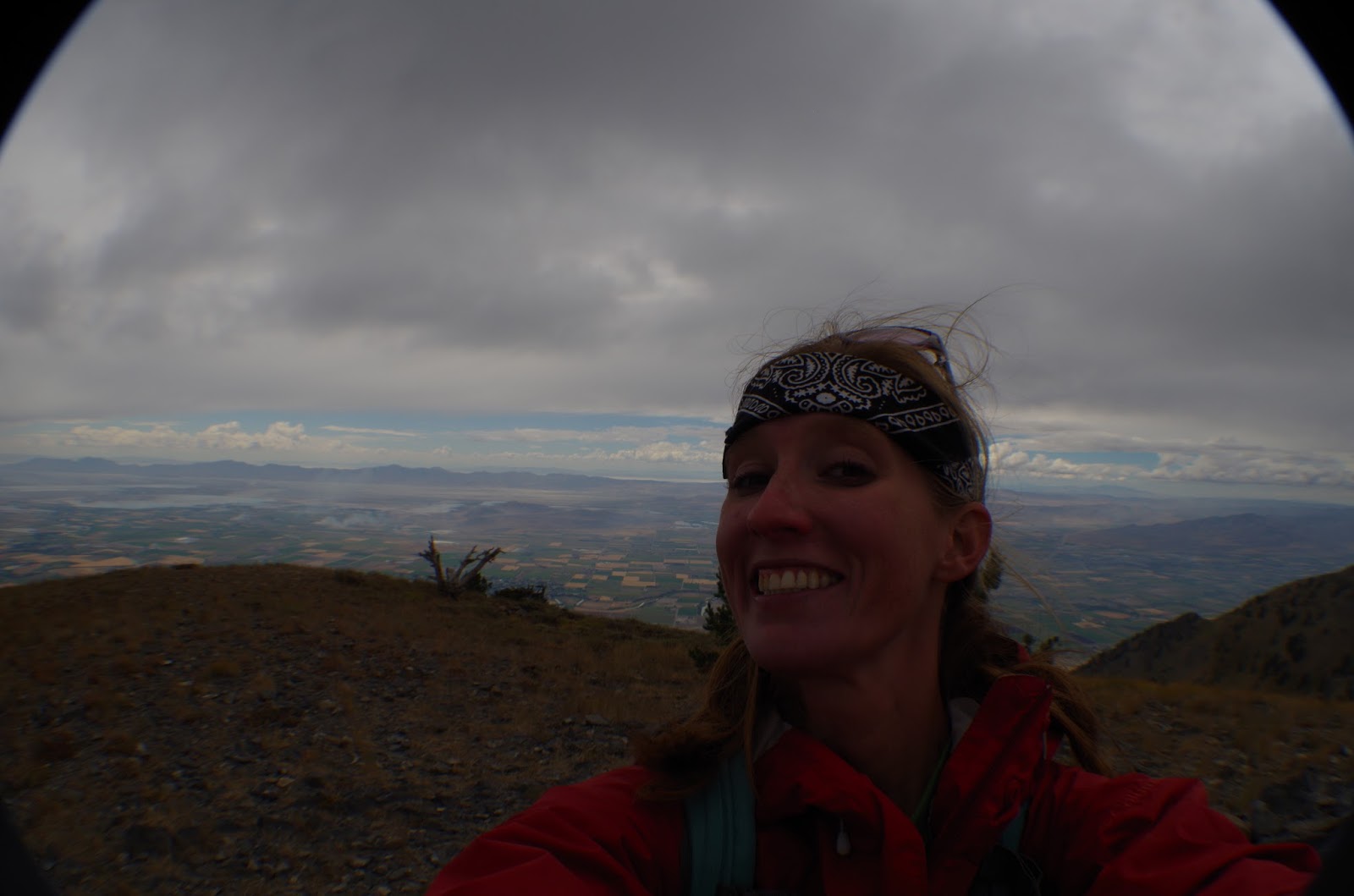
Celebrating on Box Elder Peak, 9,372 feet

 This was also the day I decided to figure out my new tripod and camera remote.  It was quite rainy that day and very windy at the top, so things did not go smoothly:

Trying so hard.  

 As I went back down the mountain my legs certainly felt the burn of a 4500 foot elevation gain and loss, but it was still really great to be able to see both my home in Cache Valley and my PhD study area in Box Elder County from the same place.    While it's a pretty grueling hike, the views and history and time to think are wholly worthwhile, I recommend everybody visit (and bring ibuprofen).

Box Elder County from Box Elder Peak
Coming Soon - the rest of my solitary vacation, including the Spiral Jetty, Antelope Island and Deseret Peak.  

Friday, September 6, 2013

Capsaicin

Why, you might ask, am I blogging at 12:30 at night?  A valid question, I've had a full day of work, several hours making salsa, and I'm going to get up at 5:30 a.m. for a bike ride tomorrow.  Despite all of this, I'm going to stay up for at 30 minutes more so I can keep rubbing a mixture of baking soda and milk on my face in an effort to prevent my skin from bursting into flames.  Tonight I had an adventure with Capsaicin.  

What, you may ask, is Capsaicin?  Capsaicin is the chemical responsible for chili pepper's spiciness, it's what makes them both delicious and dangerous.  I knew a bit about capsaicin before this incident; for example, I knew that it caused both tastiness and pain reactions in the body's receptor cells, and that it is better neutralized by milk than water.  These facts will come back to haunt me shortly, but I'd like to share some newer fun facts I learned about capsaicin tonight.  

1.  Capsaicin is present in highest concentration in the white pithy material pepper seeds are attached to.  These are the membranes most salsa recipes recommend you remove.  
2.  Capsaicin is hydrophobic, that's why water doesn't alleviate the burning pain.  In order to treat the pain you need something that acts like a detergent to bond with and carry away the capsaicin molecule.  Or bread, bread and rice do good.  
3.  The heat from peppers is measured on a Scoville heat scale.  According to Wikipedia's Scoville scale, the Cayenne peppers I was chopping tonight are rated between 30,000 and 50,000 Scoville heat units, far above the Jalapenos the recipe called for, on the same level as Tabasco peppers (but above Tabasco sauce).  
4.  A quick Google of the word "Capsaicin" reveals that medically, capsaicin is used as a topical pain reliever (most often in arthritis creams), in the treatment of cluster headaches, and as a way to improve circulation.  Capsaicin can be found in bug repellents and it is the primary ingredient in pepper spray.  Also of note, animal reproduction studies have shown that capsaicin poses no risk to fetuses if pregnant women are exposed to it.  

More practically, I've often heard you should peel and chop peppers with gloves on so your fingers don't start to burn.  Just two weeks ago I was making salsa and repeatedly touched and burned my face after chopping peppers.  But it wasn't terrible, just a little uncomfortable.  Then tonight I made salsa with my really spicy peppers, not the garden salsa peppers.  My fingers were pleasantly warm throughout the effort, and I could tell where I had touched my face because there were warm spots, but nothing terrible.  Then as I went to go to bed I itched my nose real good and it nearly caught on fire!  
The offending peppers, before they ripened, carefully protected under bird mesh.  


I tried breathing through my mouth, putting a pillow over my head, crying "Why me?"... Nothing worked.  I'd been washing my hands regularly, but knew that I'd likely just have to wait for the pepper residue to wear off because it is hydrophobic.  Another quick Google, through watery eyes, suggested a few treatments that included milk; milk and baking soda; milk, sour cream and yogurt; vasoline; aloe vera, toothpaste with menthol, and rubbing alcohol.  I dislike milk in general.  I'm fond of it on my cereal and mixed in with other things that make creamy sauces, but I do not like milk by itself or on my skin.  So first I tried applying rubbing alcohol to my nose and upper lip, but that didn't seem to make things better or worse.  Next I tried Sooth-o-cain (lidocaine + aloe vera), and that felt worse.  Immediately after that I tried rubbing the Sooth-o-cain off and applying A&D cream (because I don't have any Vasoline), and things didn't get any better and now I couldn't breathe through my nose at all.  In desperation caused by my burning face and hatred of milk,  I took a cold shower, hoping that my hippie, oil-based soap might do something or that the temperature would at least cool my burning face.  But that just made things worse to the point I was jumping up and down in the shower (as quietly as possible, because it was midnight) cursing my luck.    Defeated and crying, I left the shower to make a paste of milk and baking soda, which I applied tentatively to my left ear (because it burnt the least), and things got better.  I spent several minutes caking my face, ears, parts of my inner thighs, and my right arm pit in this wonderful new solution, and it looked like this:


And it worked, my face feels a little dry, but generally great and absolutely pain free.  Now I think I will sleep the sleep of someone who's had a hard days work (or my dreams will be haunted by long, skinny, cayenne peppers chasing me down why I run like molasses, unable to scream).  If anyone has a hankering for some really spicy tomatillo salsa or pico de gallo, come over to my place because I'd be happy to share.  Also, along with the fun facts I've shared about capsaicin, remember this: process peppers with gloves on, do not touch your face while making salsa, and definitely do not pop an ingrown hair with salsa hands.  

Friday, August 30, 2013

Why I Needed An Adventure

I wrote part of this before I ran out the door to have an adventure, part of it while I was hunkered down in a tent hoping not to be struck by lightning, and part nursing my poor tired muscles at home while going through the 800 pictures I took on my adventure.  Hopefully there is some logic to it all.

I needed a vacation so much.  A solitary vacation.  It's been a long time since I had a solitary vacation, more than 2.5 years, and I first justified it by claiming that no one else could take Tuesday through Thursday off like I could.  But the truth was I just needed to turn OFF.  After a long Spring semester at USU, scientific conferences, another intense field season, and my grandpa dying I just needed to stop thinking and start doing.  I love my vacations with Brent, in fact the 2.5 years since my last solitary vacations and the 2.5 years I've been dating Brent line up almost exactly.  But we usually go on climbing trips, and climbing is a necessarily ON task because of the need to maintain safety and communicate between climber and belayer.  I felt a strange need to make sure that everyone knew I wasn't leaving Brent behind, I'm not mad at him or anything, but then I realized that Brent didn't question any of this and felt really great about my dating choices because he seems to totally get it.  Yeah me!

In addition to the needs for vacation listed above, I was just feeling crappy.  I hadn't been sleeping well, I had no motivation to do work, and my insides hurt.  It was probably stress, but my insides felt like there wasn't enough space for all my organs, I felt squished and tight.  My legs were screaming at me all the time to get out and stretch them.  I needed to do something so active my legs would scream at me to stop and I would sleep soundly because I was physically exhausted.  So I came up with the idea for the Great Salt Lake Spectacular.  I've been eyeing a few mountain peaks all summer long, Frary Peak on Antelope Island, where I've been before; Box Elder Peak, which is the highest point in the Wellsville Mountains; and Deseret Peak in the Stansbury Mountains, which stares me in the face everytime I find myself south of Farmington, Utah.  What greater way to justify a vacation than to spend a few days viewing my area of study (Great Salt Lake wetlands) from high points?

It was pretty magical when I started hiking.  My legs and back loosened up.  Eventually my hips released all their tension.  I fell asleep my first night within minutes of putting my notepad down.  I always leave on such trips intending to attain a Zen-like mastery of my emotions, but they're really just an emotional roller coaster.  Just ask my mom, I cried at her for no good reason on Wednesday morning, but it wasn't alarming to me, it's just the emotions that come with an adventure.  My final day I was finally able to articulate my need for solitary adventure and here it is:

Why do this?  Why live through the fear and pain of an arduous solo vacation?  Because I have four limbs, 20 digits and more than 300 pairs of muscles, and they all work!  Because when those muscles stop working, I want stories to remember so I don't have to relive the same handful of events over and over.  I want stories to tell!  Because there are amazing things in this world and interesting people to meet and you only find them out in the wild.  Because I don't want to bust my ass building a career all the time, I WANT A LIFE!  I just want to live!  Because I think those moments when you have to stop and say "Oh my gosh, how amazing is it that I'm right here, right now, experiencing this great thing?" are critical to living a happy life.  A vacation guarantees I have those moments that make me stop and babble about how great things are right in this moment, just ask Brent about our climbing/mountain bike trips, I can't stop grinning and enjoying the great things we're privileged to because we decided to go up to wherever we are.  And because the most delicious pain in the work is the self-inflicted pain I feel after throwing myself against rocks, through running or biking or climbing, and I've missed it in all the mud-racking and desk-slaving I've done as a student.

So that's why I need vacations.  My mom called this my Neener-neener vacation, because I was essentially saying "Neener-neener, I'm going on vacation while you all start school and go to work."  But there were some philosophical underpinnings too.

I've got big plans for some science-laden blogs about my Great Salt Lake Spectacular(!), but before that I'll just throw out some pictures of the highlights of said Spectacular:

1. I tried to figure out my new tripod and camera on Box Elder Peak (bad idea), but also got to see my home (Logan) and my study area (Great Salt Lake wetlands) from one place (great idea).  I also met a man in his 50's (at least, maybe even 60's) going up and down and up and down the Wellsvilles via unconventional routes, he told me I was doing great.  I'm inspired.


2.  I got to sit on the Spiral Jetty all by myself for an hour.  That's never happened to me before.  I got to think about how the rocks must have changed being flooded and dried and flooded and dried over the last 40 years.  I got to think a lot of about salt.  I got to sit and just ponder, and that's nice.


 3.  I stood atop Frary Peak on Antelope Island and howled at the top of my lungs (literally).  I was timid at first, but found that the only way to really howl is to through your head back and use the full force of your voice.  It was invigorating.


4.  I got to float with a flock of Red-necked Phalaropes on the Great Salt Lake.  When the entire flock flew away it sounded like the wind rushing out of no where.  It was amazing.


I got to see a neon Great Salt Lake sunset and then run and hide from a thunderstorm in a tent I hadn't liked until that night.  I spent my entire kayak trip thinking "There's no way in hell I'm going to be caught by a Great Salt Lake microburst storm in a Duckie" then I got caught in such a storm in my silly little backpacking tent.  But the sunset was great and the storm passed, and I talked to my dad and mom that day, so the love of my family was fresh on my mind.  


I hiked Deseret Peak in the Stansbury Mountains.  I'd never been to these mountains, but I've been oogling this peak from my field sites for months now.  At 11,031 feet it was the highest point of this vacation and the highest point of the entire year.  This hike produced the most suffering (because it was Peak #3 on Day #3) and the most exclamations of "Holy sh*t, this is my life and it's amazing!"  These mountains are beautiful and rugged and there were only 3 other people in the entire wilderness area (as far as I knew).


I saw the remains of the Patch Springs fire that came through two weeks ago.  I thought I was actually seeing the fire itself, but it was just ash that got caught in the wind.  I also thought I was going to see another fire start due to impending thunderstorms, but that didn't happen either.  It was so cool to see first hand how fire moved across these mountains, the weird little patches of burnt trees uphill from entire mountain sides that burned.  I also came across years-old burns where smaller things like wildflowers and grasses had already come back.  And I rubbed some soot on my face, because that felt right.  


All in all it looked like this:


And you, my dear reader, have lots to look forward to on this blog because I'll be writing about pluvial Lake Bonneville and how the Wellsvilles looked during the age of the dinosaurs, the ecosystem of our mightly Great Salt Lake, and fire ecology.  There will probably also be extensive talk about how cool wetland plants are.

Thursday, August 15, 2013

Farewell to an Amazing Grandpa

My Grandpa Fisher passed away and it's gotten my thinking in the way that the passing of amazing people should.  Really, it's been a long time since I really felt the need to use the term "passed away" instead of "died", but I remember now why "passing away" is such a comforting term.  My grandpa died peacefully in his home, and while it was unexpected, I am so happy he was with his wife in a place he could call home.  There is a big piece of me that feels regret for not taking more advantage of the time I had with him, but the largest part of me is grateful for the time I had.  After I got off the phone with my mom I was a little weepy, but immediately went in search of this picture, because it embodies pretty much every memory I have of my grandpa:


My grandpa was a story teller.  Every time I saw him he had a different story to tell.  It made it so every time I saw my grandpa I learned something new about him. Really.  The last time I saw Grandpa Fisher was his 90th birthday celebration, where I learned he dabbled in geology.  Seriously.  In 29 years of chatting, Grandpa's interest in mining hadn't come up because there was so many other interesting things he had done that we could talk about.  I can't be too sad about the things I didn't get to hear, because Grandpa had 6 kids and I don't even know how many grandkids.  I'm really looking forward to hearing what they remember.  I'm looking forward to talking to my dad, who used to go watch basketball games with Grandpa and chat about computers and who knows what.  I'm looking forward to talking to Aunt LM, who visited my grandparents on their mission (where she met her husband).  My sister, Liz, also has some great insights because she spent her summers chilling with Grandpa and Grandma while they were enjoying their retirement in the middle of nowhere.  And I'm dying to chat with my mom, who experienced so many terrifying vacations in a Motor-Home with Grandpa behind the wheel, learning about the country at 90 miles per hour.
Until then, I'll be reliving my happy memories of Grandpa.  Here are the highlights:

1.  Singing, especially The Piggy Song.  Grandpa lived a few blocks away from us for a few months of my teenage years, when Courtney and my cousin Sabrina were quite small.  I remember him sitting down with them and singing his version of "This little piggy when to market.  This little piggy staying home.  This little piggy was an boogy woogy piggy and boogy woogy piggled all the way the home."  If any one can supplement the lyrics that I've forgotten, I would love it.
My mom has also told us about thinking that Grandpa had written a song about her, MaryAnn.  It might have been childhood trust, but I think it was the convincing nature of his singing that made my Mom think the his MaryAnn song was about her.

2.  A flare for education.  It's been said that Grandpa doesn't like having a boss, but he loves working, and I definitely agree with that.  I chatted with Grandpa while I was getting a degree in wildlife and he talked about his experience travelling the globe with the Air Force and seeing the different biological communities around the Mediterranean Sea, the Philippines, Illinois...  He'd seen and really SEEN a lot of things.  When I got a Master's degree in water policy I found he had served on a county Water Board and still enjoyed talking about Prior Appropriation water law.  When he heard I was getting a PhD in Ecology he told me "I wish I had gotten more education.  I started studying geology, but the mine boss could pay me more to work rather than go to school, so I learned as much about geology as I could looking over the mine."  And I can only imagine what he learned about geology overlooking mines, because he had such a sharp mind.  My dad almost always spent time working on computers with Grandpa when we went to visit, and from what I could overhear, it was just as much learning and troubleshooting.  (And on a very selfish note, it is so great to have people supporting your education goals, at very dark times in this PhD journey, knowing Grandpa thought I was doing something worthwhile meant so much it actually produced a physical response, I had to hug him.)

3.  A Life Long Love. Grandpa was married to my Grandma until she passed, which was more than 10 years ago (maybe even 15, I can't quite figure it out right now). He's been married to Grandma Elaine since 2000 (?).  He knows how to commit and make it work.  Up until today, thinking about older couples living alone was the saddest thing I could imagine (really, just ask Brent about how much I cry in sad movies with old people, I cry a lot) because I always thought about Grandpa Fisher and Grandma Elaine and the Loves they have lost.  While I am very sad for Grandma Elaine, who has seen the death of 3 husbands, I am so happy that Grandpa may be reunited with Grandma in whatever afterlife exists.  Beyond this distance and sadness, the love I got to witness between my grandma and grandpa while they were both alive will stay with me forever.  My grandma had rheumatoid arthritis for much of her life, and it looked like Grandpa rolled with it really well, learning how to dress her, and what part of her appearance really mattered to her. Listening to their back-and-forth as they negotiated their way up my parent's home stairs was one of my favorite things, because they had it down packed if they were going to make it up they made it up, if they were going to stay in the car, we met them at the car.  And his sorrow when she died has been breaking my heart for 15 years now (she died when I was 14 or 15).  I remember the way he wouldn't follow her casket out of the church, and I don't know his reasoning, but I like to think it was because he preferred to remember her alive rather than in a casket.  What I remember the most is his distress while Grandma was in the hospital, feeling terrible because she was in pain and he couldn't stop it.  I could see his love evident in his pain, he would rather let his wife go than see her attached to ventilators and IV tubes struggling for breathe.

That there is really the most comforting portion of the death of my grandparents.  They are no longer alone.  They are with the people they married in the 1940s looking down on their progeny and laughing at our hilarity (that's what heaven is for me, lots of laughter).

So, if any of you have memories of Grandpa Fisher you would like to share, please tell me.  I'm so ready to hear about all the awesome things Grandpa or Grandma did that I haven't heard about yet.

And Grandpa, Grandma, if you're intercepting the Interwebs from your place, know that I love you.  So much.  I love the memories I have of you and I love the family you've raised that will keep those memories alive.

Update #1  - an amazing picture my sister Alex drew of Grandpa


Update #2 - an amazing picture my sister Courtney had of Grandpa with her and our cousin Sabrina