Showing posts with label Moab. Show all posts

Wednesday, February 7, 2018

Uranium was named for the planet Uranus

In my quest to more be skilled generally I’ve been working on mapping skills by downloading interesting-sounding data layers from the internet and trying to make something out of them.  Most recently I made this map of Utah mines [1]:

A few parts of the map struck me:
  • Fluorine-fluorite (coded ‘F’ in the data) and Uranium (coded ‘U’) are often mined in the same places, leading to the attribute table commodity code ‘FU.’  This is funny. 
  • The sand and gravel pits follow the base of the Rockies and length of I-15 quite nicely.
  • Look at all those uranium mines. I was in one of those once. 

I think the Cold War is interesting.  It’s amazing that during my lifetime but not in my memory Americans lived with the legitimate fear of nuclear war (it is not amazing that we are re-living this fear).  That between 1947 and 1991 we were engaged in an arms race that produced nuclear warheads small enough for three to fit on a single intercontinental ballistic missile and each capable of producing a 475 kiloton explosion (that’s equivalent to 475,000 tons of TNT)[2].  The first nuclear bomb, dropped in 1945, was almost 20 times heavier with a 15 kiloton yield[3].  The U.S has LOTS of nuclear weapons, which required lots of uranium.  While we’ve begun slimming down our stockpile of nuclear weapons, hundreds of abandoned uranium mines in Utah currently bear witness to that crazy period of time. 
Look at this stuff.  Isn't it neat?
Abandoned mines are an environmental hazard but abandoned places are also irresistible.  Brent, Karina, and I had planned for a day of mine exploration during our 2015 Spring Break trip.  I downloaded a list of uranium mines and we set off to look at the closest mines… which turned out to be active processing mills (read: do not trespass there).  This was disappointing, but Plan B was to drive the roads in the part of San Juan County with the highest density of active mines in hopes of finding something abandoned.  And it worked. 
Speak friend and enter  
Uranium is a heavy metal that is found in rocks, soil, and water.  It’s way more common than silver or gold.  Uranium can move through the earth with groundwater, driven by changes in oxygen availability that will keep the uranium bound to water or bound to rocks[4].  Sandstone can be lousy with uranium because it is porous (so uranium-laden water can move through it) and because most sandstone deposits were formed near or below ancient seas, where the oxygen availability fluctuated a lot.  It wasn’t a coincidence that the cliffs we were exploring had bands of red and green rock that showed when oxygen was (red) and wasn’t (green) available millennia ago.  
The grey rock coming out of the chute and below it is uranium ore
When mining, the key is to find uranium-bearing rocks that have enough concentrated uranium to make digging a tunnel, carrying the rocks out of the ground, and transporting them to a refinery worthwhile.  Then a refinery will need to see reason to crush, heat, and spin the ore until it is enriched enough that it can make atom-splitting chain reactions (the physics and chemistry, of course, are more complicated, but that’s the gist of it)[5].  Uranium by itself isn’t very radioactive at all and wasn’t the real threat while we were in the mines. 
Tunnels
Side note.  I’m also think water law is interesting and it follows a lot of the rules of mining. Did you know that the General Mining Act of 1872 still stands as the rules for how one claims and works a mine.  1. First to claim it owns it.  2. Mineral rights are separate from land rights (you don’t own the minerals below your home).  3. You have to put in $100 of labor per year to keep your claim valid. 

Only slightly less magnificent than the Door of Durin
The mines we explored were three separate claims with interconnected tunnels established in the 1950’s. The ores in the mines were a mix of uranium, vanadium, potassium, and sulphur; in practical terms, there were a lot of yellow rocks[1].  Prior to the Uranium Boom in Moab, mines extracted radium (for medicine) and vanadium (for making iron steel stronger), both of which are found in the same places as uranium[6].  We left the tunnels with mild headaches, which might have been due to vanadium gas. 
Note the white calcite and yellow salts
The Uranium Boom (approximately 1952-1961) was wild.  Staking lots of claims was profitable at that time because the U.S. government paid a guaranteed price for uranium and the Colorado Plateau had a lot to offer.  But as mentioned above, uranium isn’t uncommon and the market quickly became saturated and the government stopped buying uranium.  Most mines were abandoned by the 1970’s, leaving behind structures, mining refuse, and any equipment that wasn’t worth the cost of moving.  Miles of underground tunnels and heaps of uranium slag are just one facet of the unintended consequences that came to Utah with the Cold War arms race, along with stockpiles of neurotoxins in the West Desert and down-winder cancer deaths in southwestern Utah. 

We wandered around a couple miles of underground tunnels where we experienced true silence and darkness when we dared turn our headlamps off.  We found the remains of blasting caps and earthmoving machinery.  I discovered that I feel very uneasy underground while Brent is emboldened.  In the first tunnel he pushed ahead while I was farther back, taking very cautious steps.  Karina was caught in between us, but I found the bravery to lightly skip up to her, making sure not to take any heavy, earth-shaking steps.  Given how quiet the tunnel was, I thought I could use my inside voice to alert Brent to my fear and get him to come back.  I spent minutes saying, ‘Brent.  Can you come back here?” in a volume that doesn’t deserve an exclamation point and I got really frustrated that he never came back.  But I couldn’t yell for fear I would cave in the whole tunnel. 
My Fellowship of the Tunnels
The tunnels all went deeper into the sandstone, but we had to stop at the depth of the regional water table, below which the tunnels were flooded.  That is where we caught up to Brent, who promised he had not been ignoring my quiet pleas.  Some entrances required crawling into, which felt intrepid.  One entrance was quite large and grand, like the Mines of Moria.  It was exciting to get a glimpse into the semi-recent past and to have it all to ourselves.  The threat of trolls and Balrogs made it all the more interesting. 
Ever intrepid Karina
The uranium mines in the Four Corners Region still have tens of thousands of pounds of uranium ore left, but the cost of extraction is more than the price of the ore.  Like abandoned conventional weapon blast sites and missile launch pads (which I will detail later), they show what Utah was like during the Cold War. 

 Sources:
[1] Utah Automated Geographic Reference Center, “Minerals.” Geoscience, 2017,  https://gis.utah.gov/data/geoscience/
[2] “W87.” Wikipedia, Wikipedia, 5 Feb. 2018, https://en.wikipedia.org/wiki/W87.
 [3]  Wellerstein, Alex. “Kilotons per kilogram.” Nuclear Secrecy Blog, 23 Dec. 2013, http://blog.nuclearsecrecy.com/2013/12/23/kilotons-per-kilogram/.
 [4] “Uranium ore.” Wikipedia, Wikipeida, 5 Feb. 2018, https://en.wikipedia.org/wiki/Uranium_ore
[5]  Rhodes, Richard. Making of the Atomic Bomb.  Simon & Schuster, 2012. 
[6]”Utah’s Uranium Boom.” Utah History To Go, State of Utah, 2018,  http://historytogo.utah.gov/utah_chapters/utah_today/utahsuraniumboom.html

Tuesday, October 14, 2014

Type II Fun - Tombstone Butte

I'm really struggling to get back into the swing of things at work.  I finished my field work for the season and feel like taking it easy, but there's still work to do.  There's also a lot of outdoor fun-having to be done in this beautiful autumn weather, which has put me in a bit of a panic.  In an effort to satisfy both of these feelings (need to work, need to play), I've decided to recount a vacation Brent and I took to Moab in April.  The plan was to climb Tombstone Butte and Lost World Butte, soak up the sun, maybe chill out in the hammock.  You know, an easy going rock climbing adventure.  What came about was less easy going, more hiding and suffering, but still fun.  You know, Type II fun.


According to outdoorsy types (i.e. Backcountry.com), there are three types of fun ranging from fun while it's happening and fun to remember (Type I) to miserable while it's happening and miserable to remember (Type III).  Type II fun lies in the middle, miserable while it's happening but good to recall; Type II activities include getting lost, rained out, blown away, or generally beaten by the elements.  Remembering Type II trips usually involves a pretty selective memory, but there are very real rewards like unexpected views or events that you'd never have seen if things had gone according to plan.  Our visit to Tombstone Butte falls into the Type II category, things did not go according to plan and there was some suffering, but no regret and it's been really fun to recall.


The desert southeast of Moab.  
I'd spent the weeks before our trip psyched to go climbing in the Southern Utah sunshine because I hadn't been on a vacation in two very busy months.  I needed a vacation.  I deserved it!  And it started out according to plan - we arrived before midnight, skies were clear and we found a flat area to pitch our tent free of cow poops.  Then we woke up to this view:


I do not like cows.  I believe they signal impending doom.  
Cows!  Thank goodness we decided to sleep on the other side of that fence.  Tombstone Butte lies on BLM land between Green River, Utah and Canyonlands National Park, where there's a bit of grazing and a fair amount of OHV use, but generally very few people.  I love it.  Tombstone Butte is a 300-foot tall, square block of sandstone, thus classified as a butte rather than a tower, but it begs to be climbed just as much as any other free-standing chunk of rock does.  The Rigor Mortis route is particularly eye catching.  Tombstone caught our attention a while back when Brent and I were aiming to climb Lost World Butte, and has been our camping area of choice when we're in that area (good views + free site = best!).  The butte is composed on Endtrada sandstone on top of a pedestal of Chinle sandstone.  I love sandstone, but honestly, this is the worst sandstone.  The size of the sand grains in the rock and the pressure the rock was formed under determine the strength of the rock itself.  While it's not the softest, Entrada sandstone is pretty dang soft and small ledges are prone to crumbling if you look at it wrong.  However, much of the climbing in the Moab area is on Entrada sandstone because it weathers into towers and buttes like this.


Tombstone Butte
The whole thing started out typically Type I.  I dawdled taking pictures while Brent racked up and it only took about 10 minutes to get to the start of the climb.  We did our best Bear Grylls run/jump/getting psyched approach.  Like many towers, the first pitch was a forgettable chimney, dirty and soft, but easily climbable.  Pitch 2 was real Type I stuff - a beautiful, sharp crack that was challenging to lead and fun to follow (and Brent got to the use a piton I got him for Christmas).  


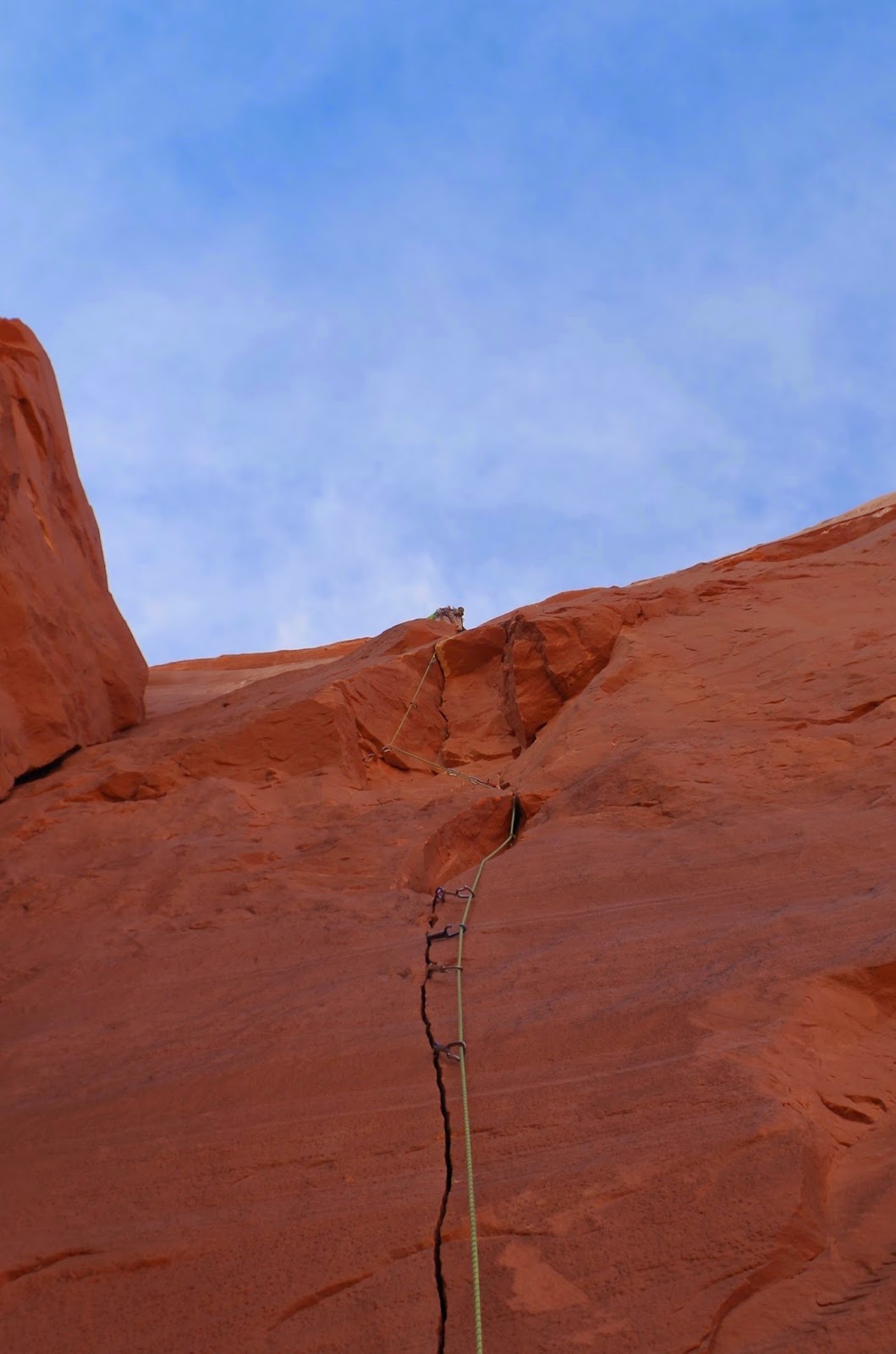
Pitch 2 - Rigor Mortis - Tombstone Butte
I might call our feelings at the bottom of Pitch 3 confident.  We were about 200 feet off the ground, skies were clear, and the crack left to climb was quite striking to look at.  We were ready for the most picturesque and difficult part of the climb.  This is when we entered the Type II zone, delimited by the clear memory of the songs stuck in my head.  The rest of the narrative will follow the lyrics of "We Can't Stop" by Miley Cyrus and "Holy Diver" by Dio because they were stuck in my head and definitely affected the quality of the experience.  Miley lyrics will be in blue, Dio in red.  I highly recommend watching the linked video to "Holy Diver"; you can click the link to listen to the Miley song if you don't know what it sounds like, but having typed out all these lyrics, it already seems like an unfair comparison.  [Note: Brent does not support my knowledge of Miley Cyrus lyrics, if there was any music stuck in his head it was totally bad ass.]


The start of Pitch 3 was clear but difficult to execute as it required some stretching and there was a loose block at the top (and bless his heart, Brent doesn't want to kill me with a falling rock) [It's our party we can do what we want.  It's our party we can say what we want].  The next 30 feet were a huge challenge though.  I've mentioned before that aid climbing is slow (and repetitive, like Miley's lyrics).  Instead of climbing up the wall like you would climb a ladder, using your hands and feet to move you up and leaving protection as you go just in case you fall (i.e., free climbing), aid climbing is more like building a ladder as you go.  Gear is placed in the features of the rock and attached to 'aid ladders' (webbing sewn into steps), the climber moves up by pulling on and stepping up the ladders.  In this way you can climb cracks that are too thin and small to climb using the strength of your hands and feet alone.  Aid climbing can get you to lots of really cool, seemingly un-climbable places, but it requires lots of gear.  Climbing without all the gear you want is decidedly not Type I fun.  
Note the aid ladders and harness full of gear.  
As Brent moved past his first two pieces of gear he found the crack could take a #0.3 Black Diamond Camalot (12.4 - 21.2 mm in width) ('cam') perfectly... and only the #0.3... nothing smaller or larger... for at least another 20 feet.  He could continue to "walk" the #0.3 up the crack, but it would leave an increasingly longer span between himself and his last piece of protection.  [It's our party we can love who we want.]  This simple math, measured by the rope, quickly added up to a huge risk, but with a potential payoff.  A fall, caused by that one #0.3 cam slipping or blowing out of the crack would lead to 1) shocking another tiny cam; or 2) decking on the belay space below.  But if he succeeded the crack might get wider or more narrow and allow him to use rock protection ('gear') of different sizes.  But it might not.   Since he was literally 10 feet above my head we could talk through this dilemma easily, but the answer wasn't easy.  [We can sing what we want.]
Note how far away that bottom cam is, that's the #0.30.  
The question came down to this: is the risk of falling low enough to justify continuing and increasing that risk, given the work we'd already put in and the reward of topping out?  And he asked me what I thought he should do.  Brent almost never needs my help with risk assessment.  I question myself all the time and rely heavily on Brent to help me assess risk, but he's the wiser and more skilled of us.  Because it was his life at risk I just didn't feel like I could make the call.  [But I could sing "Red cups and sweaty bodies everywhere.  Hands in the air like we don't care."]  I was literally no help.  I couldn't see when the crack would change size, but neither could Brent.  I couldn't tell how well that critical cam would hold, but he couldn't tell how long it would be before he could use something else.  We could both see how far away from the deck he was, we both knew how far we'd come and how much we'd like to reach the top...  It was a really tense moment (for me, Brent doesn't seem to remember it this way).  ['Cause we came to have so much fun now.  Bet somebody might get some now.]  I didn't want to tell him to back down because I trusted his skill, but I didn't want to tell him to move up because I didn't want to push him to put himself at more risk than he wanted, so I said the least helpful thing: "I can't help at all with this.  If you move up I'll be really worried and I don't see a way to climb down.  But I won't be upset if you want to bail."  Guess what was happening while I was doing all of this worrying.  Brent was continuing to climb, which continued to change the arithmetic of the situation.  [If you're not ready to go home, can I get a hell no?]
Moving up.
Then something amazing happened: the crack, through eons of erosion, widened enough to begin using more gear, spaced at more reasonable intervals.  But that's not the end of the difficulty.  ['Cause we're gonna go all night, 'till we see sunlight, alright.]  The crack got varied but also really soft.  And it was a really long pitch, ~180 feet.  [So la da di da di.  We like to party.]  And the wind started blowing, and it never stopped.    It was a difficult climb that stayed difficulty.  [Dancing with Molly.  Doing whatever we want.]  Brent spent about three hours climbing the third pitch, mostly out of hearing distance, so I had hours to stand there and think (while also giving a competent belay). [This is our house.  This is our rules.]   I studied my anchors (solid, painted nicely) and my Cinch and wondered if I'd ever read the owners manual (no);  [And we can't stop.  And we won't stop.]  I enjoyed the views and practiced left-handed SLR camera selfies (never take that brake hand off the rope).  [Don't you see it's we who own the night?  Can't you see it's we who 'bout that life?]  During this musing a few people pulled up next to the butte in side-by-side ATVs to watch and, thank the Lord (!), someone was listening to Dio loudly on their stereo.  
The Cinch
The top half of the pitch continued at a regular aid climbing pace (even and slow), but I had a great song to ponder the lyrics of.  [Holy Diver.  You've been down too long in the midnight sea.  Oh what's becoming of me?]  I still don't know what "Holy Diver"is about, but the song structure is more pleasing than that other song I was playing in my brain and the lyrics are more aggressive.  [Ride the tiger, you can see his stripes but you know he's clean.  Oh don't you see what I mean?]  Fact: after this trip "Holy Diver" became my power song when I program because it makes me feel like I can make the computer do what I want.  [Gotta get away.  Holy Diver.]  Anyway, I was enjoying myself there, safe from the breeze in my favorite flannel.  If I played my cards right I could start climbing with my new "Ride the Tiger" mentality.  And then it was my turn to climb.  [Shiny diamonds.  Like the eyes of a cat in the black and blue.  Something is coming for you.]   
The view from the bottom of Pitch 3
The first 30 feet of the route that Brent had struggled with were literally heinous (utterly odious or wicked)!  That lower part of Pitch 3 was a pretty perfect sized crack to jam my fingers in but was too tight for my feet to get any traction on, so I could hang but I couldn't actually move up.  [Race for the morning.  You can hide in the sun 'till you see the light.  Oh we will pray it's all right.]  It was a mess to belay.  Brent was more than 150 feet away and the wind was blowing, but that didn't stop me from yelling "Pull the rope!" every time I thought I'd lifted my hips enough for there to be slack in the rope.  [Gotta get away.]  Even though there wasn't any rope to take in and it is difficult to winch someone up on a top belay, Brent gave it a shot. Brent told me I could aid off that critical #0.3 cam, but he'd used it for that full 30 foot stretch so it was too far above my head to reach and I didn't have any other gear to use.  [Between the velvet lies, there's a truth that's hard as steel.  The vision never dies.  Life's never ending wheel.]  I'm still not sure how I got up that section of rock (Brent probably pulled me up), but once I got my hands on that #0.3 cam and rested I was back to singing "La da di da di, We like to party." 

Brent at the top of Tombstone Butte
Most of the following 150 feet were perplexing but alright.  It took a lot of work to pull out the cams and stoppers that had been bounce tested.  There was lots of pulling and pushing and a good deal of tapping on gear, plus some strained prying with the nut tool.  [And we can't stop.  And we won't stop.]  The beautiful, brand new pink Tricam would not come out, even though I spent enough time on it that Brent had to question what I was doing.  Then it got torturous again: the crack widened and became more shallow.  [We run things, things don't run we.  Don't take nothing from nobody.  Yeah, yeah.]  It seems that at this particular section, about 50 feet from the top, a block of the cliff face had come off recently enough that the exposed rock didn't have any sort of hardened varnish, so it was just sand (read: NOT sandstone).  Everything I pushed and pulled on blew away because it was just sand.  [It's our party we can do what we want.  It's our party we can say what we want.]  How in the world had Brent protected this?  [Holy Diver.  You're the star of the masquerade.  No need to look so afraid.]


At this point in my complaining I must make a ridiculous confession: sandstone formations often look like genitals to me.  The towers make sense, descriptions of those often include the word "phallic"; but the cracks or canyon walls that are shaped like ovals with pointed tops and/or bottoms look like lady parts to me.  Thus, as I pushed my way up through this section I couldn't help but think that that must be what it looks like and feels like to be birthed as an adult.  [It's our party we can love who we want.  We can kiss who we want.  We can sing what we want.]  It felt just as silly and un-graceful as that admission sounds.  Once I got through this final difficulty I could see and hear Brent again, yay! [To my home girls here with the big butt.  Shaking it like we at a strip club.]   

Pitch 3
Getting to the top of things is usually a reason to celebrate, and it was nice to sit and catch my breathe, but it was actually quite unpleasant at the top.  It had taken me an hour to follow up the final pitch, and while I was bruising myself on the rock Brent felt like he was being punched in the back of the head by the wind.  [Remember only God can judge ya.  Forget the haters, 'cause somebody loves ya.]  On other towers we've explored the top a bit, looked for a summit register, and stretched a little before climbing down; none of that was happening there.  More than being unpleasant, the wind made exploring without a rope less safe and neither of us was interested in more wind or belaying.  [We all so turnt up here.  Getting turned up, yeah, yeah, yeahhh.]  

The top
Our choice to rappel immediately wasn't as easy as it would seem tough, because the bolts supporting the ropes we rappelled on weren't great, they weren't even OK.  All that wind (which is always stronger at the top of things than the bottom) and the soft, sandy sandstone made it so the rock the bolts were embedded in was literally blowing away.  Given time to think through things calmy we'd have probably searched for another set of anchors rumored to exist, but that didn't seem like a reasonable option.  [So la da di da di.  We like to party.]  So we rappelled very carefully, trying to keep an even speed and not bounce on the rope.  I wish I could say this was the first time we'd been left with this choice.  We arrived at the ground safely though.  


Of course there was one last selfie before we rappelled to our potential deaths
Once we were back safely on the ground you'd think the Type II fun would transition back to Type I, but it didn't.  That night a storm blew in, making climbing the next morning a no-go.  Not one to say 'quit' after driving for 6 hours to enjoy the desert, I decided to go to Canyonlands National Park for some sight seeing.  I'd never been to that park before and was definitely pleased with the views.  As an added bonus, we spent most of the day in the car with the radio, successfully dodging the stuck song issue.  


Upon returning home I looked at the Mountain Project description of the route and the first sentence stood out more clearly than on the first reading:  "Some interesting situations."  We were definitely faced with some interesting situations, even if the lyrics in my head were kind of inane.  Good times. 


Thursday, October 24, 2013

The Desert Is Best in October

I just got back from an excellent trip to Moab with my most excellent friends.  Turns out October is a most-excellent time to be in Moab, the nights are cool (or cold) and the days are warm, the crowds aren't terrible and the rock feels great.  I've been to Moab enough times it's almost routine, but there were a few new things this time through.  For one, I laid out a plan ahead of time.  When Brent and I go we usually have a few options and spend a lot of time trying to decide where to go.  Not this time!  I laid out two places we'd all go and the climbs that I would like to do.  It might be the best way to go on vacation, but it was also kind of stressful, so I'm on the fence.  The second new thing was actually a person - Emma's husband Ryan came along and proved to be an awesome addition to the whole trip. 

I've been struggling to think of a theme to link all of these pictures together.  We did some aid climbing in Arches, as well as some free trad climbing.  We also did some odd crack climbing at the Ice Cream Parlor.  I think the thing that links it all together is finding new ways to keep climbing difficult, which always reminds me of this quote
 “We do not deceive ourselves that we are engaging in an activity that is anything but debilitating, dangerous, euphoric, kinesthetic, expensive, frivolously essential, economically useless and totally without redeeming social significance. One should not probe for deeper meanings.”  Allen Stock (1967)
With that in mind, I'll start with the story of my only successful lead climb of the trip - The Pickle (5.7 C1).  It took me about 35 minutes to climb the 90-foot tower.  Put all together, it looked like this from the east -
And it looks like this from the north
What these pictures don't really show is just how tedious aide climbing can be.  To aid climb, a climber uses equipment in addition to their arms and legs to get to the top of a climb.  In this case, I used a serious of pitons and bolts drilled into the wall, carabiners, and slings tied together like a rope ladder to get to the top of The Pickle.  Modern climbing emphasizes "free" climbing things, getting to the top of routes as fast as possible with minimal impact to the rock.  So why would anyone aide climb?
Because there's nothing to hold onto.  
No hand holds
No foot holds
Nothings but a very smooth, unforgiving rock face
However, because that little tower is there, it must be climbed.  For me in particular, it was one of the few routes in all of Moab that I could climb (so long as there are bolts).  I took Brent's GoPro up the climb, which was programmed to take a picture every 30 seconds, thereby providing all of these pictures of The Pickle from the aid climbers point of view.  Observe -
Smooth rock face, save for that bolt, which I have adorned with a carabiner and will shortly run the rope through.  
Then you clip aid ladders (or slings, in this case) through your bolt or carabiner
Then you wiggle your foot into the "ladders", being careful not to snag it on the velcro from your shoes
And then you stand up, without any visible foot or hand holds.  It's kind of amazing it can be done.   
And then you start the whole thing again.  Occasionally making desperate moves like the one captured here.  
Often time resting is in order, which provides a good opportunity to look down at the belayer you're so fond of and at just how far you've come.  
Inevitably, tower climbs slab out - they go from vertical to less-than-vertical, at which point you are expected to free climb again.  
The wide angle lens of the GoPro has distorted the way the rock looks a bit, but make no mistake, the slab is the worst part of the climb.  It is scary and run out and awful.
But then you get to the top, take a breather, and bring your friends up.  
Karina was the next to make it up.  We got to have a nice chat about big life topics there atop The Pickle.  
Then Brent came up and called me a Teletubby.  
 I know, that was a long story but there's more.  Here's what it look like from the ground.
Aiding up The Pickle in the sun, the glorious sun.  
And there was a celebration dance at the top.  
Karina tackling The Pickle
Emma joined us just as we rappelled down.  It felt like it had been forever since we'd climbed together.  It was great to hang out again.  
With the sun like it was, and Emma like she is, she looked like an angel.  
Ryan proved to be good at adept at aid climbing, we were all seriously impressed.  
Down on the ground, Brent was stealing Karina's sunshine.  It was hilarious.  
But occasionally they were able to get along, soaking up their own sun.  
Brent looks especially good in the desert.  
The moon was so bright the weekend we were there.  The first night we camped below Tombstone Butte, which provided at excellent opportunity to take night pictures.
What a beautiful night under a beautiful butte. 
Watching the moon rise above the LaSal mountains while we were in Arches was also really spectacular.  I was hobbling down from the crag in my climbing shoes when the sun, moon, and mountains looked best, but this was nice too.  
All of these clear, moonlit nights did make for some cold mornings.  Our second morning we stopped by the Birthing Rock on our way to the crag.  This might be the clearest, most easily discernible petroglyph I've ever seen.


Perhaps it was the cold, but it took a few hours to really get started climbing.  But once the climbing started, it was pretty great.  Brent decided to tackle Die Another Day, a 5.9 crack climb with a killer run out at the top.
Epic climbing.  How could he not climb well with that stack of rocks to start on and those socks belaying him?  
The start of this climb kind of made me want to puke, as did the end.  Brent ascended it calmly though.  
There were base jumpers leaping off the cliffs just south of us!  It was alarming at first (it really does sound like a rock fall when their parachutes open), but then it was just great to watch.  
Someone took the time to etch these route names with map.  
And Karina created this pictograph.  
And of course we had to take a group photo at the end.  It's tradition
With vows of friendship renewed, Emma, Karina, and Ryan headed back to Provo and Brent and I spent another night in Moab preparing for my half marathon the next morning.  I sure stressed a lot about making a plan that could be fun for everyone, but in the end hanging out in the sun with my friends was really enough to make me happy.  Climbing was a great bonus.  These people pictured here are some of the best in the world.